

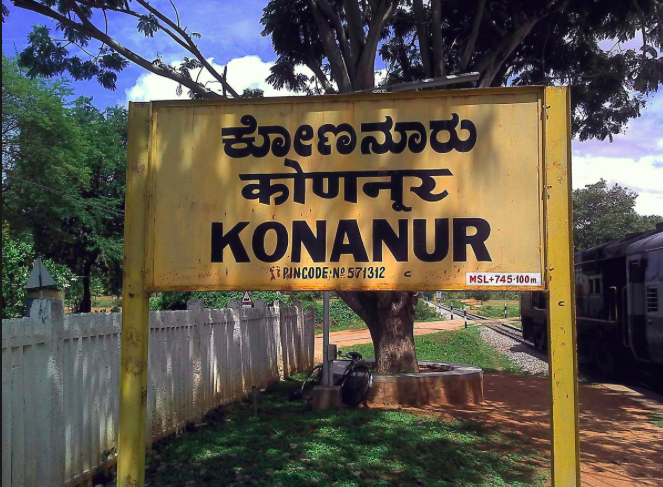
It was a small town. My school seemed a little too big for the town. The school building was at the centre of a ground with scattered patches of green grass, while all around were sand and small stones. There were two boulders in the front of the building — to the right, just by the side of a tree — where we took a breather in the shade, after running around in the afternoon heat. To the left was the flag post, which would be used only on Independence Day and Republic Day, but whose steps would be privy to our daily scheming sessions. The school compound wall ran all around. You could see boys walking on the wall, circling the school when they had nothing else to do. The main gate was made of cast iron and was old. It was always locked, perhaps to prevent cattle from getting in, or more likely to prevent boys from using it as a merry-go-round. The small gate beside it was the one that was kept open. At the back of the school, there were shrubs of Congress, urinated over and over by the boys. It was the town’s Sarkari Balakara Prouda Shale (Government Boys High School).
The dilapidated building had a Mangalore-tiled roof. In the centre and protruding forward was the principal’s office. On either side of his office and at the back were the classrooms, almost devoid of furniture and fittings, except for low wooden planks on which students sat, squatted, crouched, and even slept when the teacher was not around. The floors were of black granite and felt cool even when it was sunny and warm outside. There was a large blackboard built into the wall in each room.
You would often see Siddappa Mestru (teacher) in the verandah, straining his eyes over a thick English dictionary. He was our English teacher. It was a rarity for an Okkaliga to be an English teacher, and he held the job with great pride and sincerity. He made it a practice to improve himself by dint of hard work. Questionably, as I recall now, he did this not by studying grammar and literature, but by learning the dictionary by rote. Underlining words and memorizing them constituted his hard work. He would be seen studying his dictionary on the steps of the flag post in the morning just before the lessons started.
Then there was our Subrao Mestru, a Brahmin in a well-worn dark coat and a Gandhi cap. He was fair, tall, well-built, bald, with most of his front teeth missing. He carried himself well. He had returned to teaching after a few years in some other profession. He had constant tiffs with the principal. Sitaram, the short and stout principal, was my father’s namesake and his good friend too (not for that reason, though). Often, Subrao Mestru could be seen standing below the tree in the schoolyard haughtily, after what appeared to be another row with the principal. He would often shout at him at the top of his voice. All this would happen during our school hours, and even when Subrao Mestru was supposed to be giving us Ganitha Shashtra (Mathematics) lessons. We would sit inside listening to the uproar in amazement, not knowing completely the reason for the fracas. Of course, the boys speculated wildly, and an hour at least would be well-spent in gossiping.
On those rare days when Subrao Mestru taught us Ganitha, he would repeat the same few math problems, with no particular consideration about whether he was teaching the fifth, sixth or seventh class. Those lessons were mostly about how to find the laguththama samanya apavarthana (Lowest Common Factors). Sometimes, it was also about fractions and proportions and elaborate problems applying these principles. We were supposed to do the work on our slates while he would come around to inspect them. Sometimes, he would call his pet student to come over and solve the problem on the blackboard.
My favourite teacher was Rudrappa Mestru who taught us Samaja Shastra (Social Studies). He was a balding, venerable looking man. He wore his terrycotton shirt and slacks neatly pressed. The object of my attention and admiration was his vibhuthi, the three lines of sacred ash a Lingayath (worshipper of Shiva) wears on his forehead. I liked the way he smeared the sacred ash on his forehead — with such deftness that the lines appeared clearly separated from each other but connected at the ends with fluent arcs. There would also be a hint of Kumkuma on the bridge of his nose. The vibhuthi gave his face the glow of a pious man. He would always carry two fountain pens in his shirt pocket — one with red ink for marking test papers, and another with blue ink for general writing. I don’t remember very much how he taught, but I cannot forget his appearance and poise.
I had three good friends: Bhadresha, son of Rudrappa Mestru, Paramesha, a very short and sprightly fellow, the son of a potter, and Prasanna, whose mother bred chickens in her backyard and who introduced me to my first omelette, motte palya as they called it. Bhadresha had an oblong head and a constantly chattering mouth. He usually stood third in the class, while the first and second places toggled between me and a very intelligent looking chap called Shashi. This boy seemed very aloof towards me and I don’t remember having gone around with him as much as with the other two. Shashi was a good bowler too, in the occasional game of cricket we played in another ground across the road from our school. Cricket was alien to Paramesha. He was the supremo in lagori, played with flat stones and a ball, and soor chand, a game in which a rubber ball is hurled at one another with the intention to hurt. A good player is one who can swerve and evade the hits, but who can also get close to another player to hit him with the ball. Paramesha was also good at kusthi, the impromptu wrestling bouts on the school ground. Although small, he was rugged, and all I remember is often lying helplessly on my back and panting while he pinned me down with his very strong hands and legs.
Sometimes after school, I would go with Paramesha to his house in Kumbara Koppalu (Potters’ Colony), as I liked to watch his father at work. Potters’ Colony consisted of a few rows of unelectrified thatched houses separated by narrow lanes. Each house had an open verandah in the front, where the potter worked at his wheel. On one side you would see a mound of wet clay; on another side, rows of newly made wet pots put out to dry, and on the third side stood finished pots well done in the kiln, painted and ready to be sold. The potter’s wheel is quite like a cart wheel, made of wood, with a hole in the rim, into which is stuck a bamboo stick to turn the wheel. When a new pot is to be made, the potter puts a lump of wet clay — previously prepared — at the centre of the wheel on the hub, and then turns the wheel several times with his stick. When the wheel has picked up enough speed, the potter puts the stick aside, and works fast with both hands on the lump of clay.
What Paramesha’s father did with his hands on the wet clay was wizardry to me. In a few minutes the lump of clay would be magically turned into a smooth surfaced and beautifully shaped pot. He created pots of many shapes and sizes — tall and oval, short and rotund, and big and spherical ones. The pots coming out of the wheel were still devoid of bottoms and handles. After working on the wheel for a while, he would switch his attention to the task of making the bottoms and handles. This was another fascinating spectacle that involved patting the open bottom of a wet pot with a wooden bat (not unlike the modern table tennis bat) until a flat, thick and continuous bottom was formed. The rhythmic sound of potters patting on their pot bottoms could be normally heard in the vicinity of the colony. The potter would also use shapely wooden tools and other homemade accoutrements to form the handle, and create intricate impressions on the surface of the pot. Usually, after a set of pots are formed and dried for a week, they are taken for baking in a kiln to be sold at the weekly market every Wednesday. The pots were burnt in a furnace at a controlled temperature using dried cowdung and hay, the art and craft of which have been bequeathed to the world by the fine clan of Kumbaras from time immemorial.
I would often ask Paramesha’s father to let me try my hand at the wheel. The touch of wet clay on the hands is sensuous. The final product could never resemble what the potter created. Paramesha’s father was too patronizing to allow me to try my fancy. I would take home a small lump of clay, from which I would try fervently to make a Ganesha idol and get admonished by my Amma for messing the floor with clay and water.
I can still remember my first impression of Konanur when we arrived in a lorry with our luggage loaded in the back, with my younger brothers Pradeepa and Dilipa squeezed in with my Anna and Amma (father and mother) in a small space beside the lorry driver in the front, from Arsikere, the town from where my father, a school teacher, had been transferred. (My last brother Puttanna was later born in Konanur.) I remember too the paper dose and delicious coconut chutney we ate at an intermediate stop on our journey to Konanur. The lorry finally stopped on a narrow stone-paved street in front of the house my father had rented for Rs. 100 or so per month.
It was a country-tiled house with an open portico, and wooden pillars and stone benches on the sides. The front wooden door was thick and ornate, with a high threshold and low ceiling, so one had to be careful entering the house lest one tripped over the threshold or hit his head on the doorframe. The house was narrow and long and gave one the feeling of being in a train. It had two rooms — a living room and a big kitchen in which my mother cooked on a kerosene stove sitting on the floor in one corner — while the opposite corner was used as devara mane (puja room), and there was a passageway for dumping firewood and stuff, as well as a bathroom with a big thotti (water tank). Behind the house, there was a courtyard that we shared with the owner who lived in another house beside ours. The courtyard had a baavi (well) for drawing water when the municipal water in the pipes became scarce. My brother Pradeepa and I were proud of our skill in drawing water from the well with a long, thick coconut coir rope. The house opened out into the courtyard, beyond which was our thota (farm or garden). The toilet with an open top and a tin door was at one corner of the garden. My father had ingeniously covered the top of the toilet with a big umbrella for protection from the elements while we kids took our time with our morning ablutions.
Pradeepa had a keen interest in gardening… he practised it with occasional big brotherly advice from me. He would collect seeds for a variety of vegetable and flowered plants from the weekly fair and plant them zealously with the air of a horticulturist. He had indeed developed a good sense of the right season, right weather, right soil and right seeds. We would be very glad when our papaya, guava or nallikayi trees bore fruits, or the beans and the ladiesfingers sprouted. We even had a curry leaf tree, which we climbed to show off in front of visitors. We took a keen interest in the long row of coffee shrubs the owner had planted in the thota. Everyday in the morning after coffee, we brothers would take a customary walk in the garden and discuss enthusiastically our plans to grow white roses or seedless guavas.
This was also the time in my boyhood when I was strongly inspired by a set of small books they published in the name of BharathaBharathi in Kannada depicting great figures in Indian history like Subhash Chandra Bose, Rabindranath Tagore, Shankaracharya and Basavannanavaru. I was particularly inspired by the piety and righteousness of Basavannanavaru, a famous figure in the Veerashaiva religious cult. More likely because of the fantastic vibhuthi he wore on his forehead than anything else. I had a collection of my own wooden idols — gods and goddesses — which I arranged in a small mantle shelf in one of the rooms, in front of which I pretended to pray on a mane (wooden platform) for hours on end. I had seen pictures of Basavannanavaru writing his Kudalasangamadeva poems with a quill pen. I would pretend to write poetry in the same way. I had an obsession for wearing torn clothes since I had read somewhere that it was virtuous to live frugally. My parents never ridiculed me for my pretensions and eccentricities. They probably knew that this was only a passing fancy. It certainly was.
We brothers were very fond of cows and dogs. The household across ours reared cattle and sold milk to houses in the locality. There was a brown-and-white-coloured calf that had taken a liking to us. It would wander into our portico in the morning before our departure for school. We would scratch it behind its ears and in the ridge between its budding horns and sometimes feed it banana skin and vegetables. We liked dogs very much; from time to time, we would bring home a cute looking puppy from the roadside. Obviously, it bothered Anna and Amma so much with its whining in the night that my Anna would leave it somewhere faraway, before we came back from school.
After school, Pradeepa and I would go out to play with friends. It would be either playing with marbles or learning to ride a bicycle. We would also take a long walk to the outskirts of the town to throw stones at ripened aththikayi trees. When it was time for sugarcane harvests, we would go to the farms to pick up sugarcane sticks, watch jaggery being made in large oval basins, and if lucky get some delicious sticky jaggery paste to eat, stuck to the ends of our sugarcane sticks.
There was a cinema tent for the town near the bus station. Everyday, a bullock cart with large paper posters of the movie being shown pasted on its sides would be taken through the streets of the town. If it happened to be a Rajkumar movie, noisy children could be seen trailing the cart in large numbers. Sampoorna Ramayana and Babruvahana were my most memorable movies. We would come back from such mythological movies and pretend to be Rama, Lakshmana and so on, with homemade bows and arrows. There was a movie called Putani Agent 1-2-3, about precocious and adventurous kids, that I watched three times, every time in the lowest class — the floor — costing 70 paise at that time.
One of our neighbours was a family from Mangalore, settled in Konanur for a long time, which owned the Shivaprasad Hotel, the biggest hotel in town. They had four daughters, and a son they doted upon. Raghu, as he was called, was a few years older than us. So he considered it his responsibility to show us around the town and to teach us ball-badminton. We would hit the furry ball against the wall inside their huge house, and from time to time refresh ourselves with the dried peas from big sacks stacked there. The sacks were bought for the hotel, but it was a normal practice for Raghu to make a small hole in one of the sacks so it was handy for us to reach into the hole and dig out a few seeds for munching. Eating too much of the stuff gave you obnoxious wind. Often we would see Raghu, much to our amusement, position his rear end in a peculiar way and let go a great stinker.
Raghu’s eldest sister, Sunanda was tall and elegant with double braids. She was very fond of us kids. Raghu’s youngest sister, Yashodha was our age and quite pretty. Raghu and Yashodha would take us all to the hotel on rare occasions and we would be treated to maddur vadai and gulab jamun whose flavour and taste are distinctly etched in my mind.
During our school holidays, we would visit my maternal grandparents in Harihar (where I was born), or my paternal grandparents in Bangalore. We looked forward to this time of the year, eager to meet our huge band of cousins and relatives, excited about playing aisepaise (hide-and-seek) and jootata (catch-me-if-you-can), and thrilled about eating outside. We would look forward to the long train journey, when we played a game of our own invention that involved releasing bits of torn paper out of the window and watching them whiz past in the wind. Such simple pleasures!
~*~
 Eclectic Musings by Ranga Sitaram
One comment