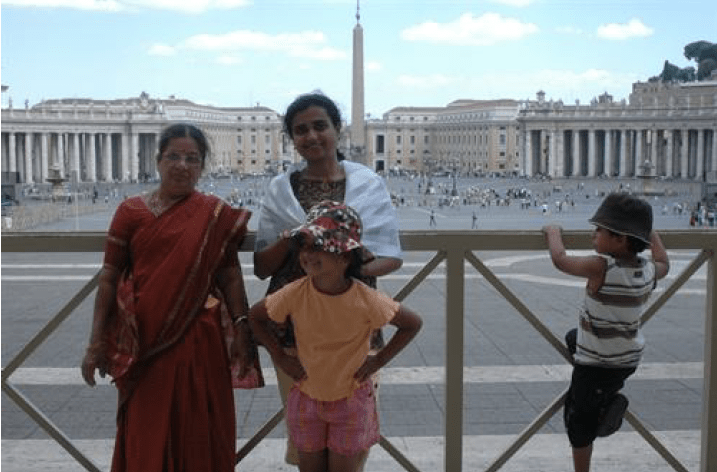
Amma has been visiting us in Germany for about 3 months now, starting in July 2007. From time to time, she would ask us what the people of this region cooked and ate, and how they prayed and played. We thought a good way to answer her questions would be to take her to Italy, the center of European culture, the birthplace of the Renaissance, and la dolce vita, the life of pleasure and indulgence.
I took a break from work, and Vani quickly cooked up a short itinerary of trips to Milan and Rome.
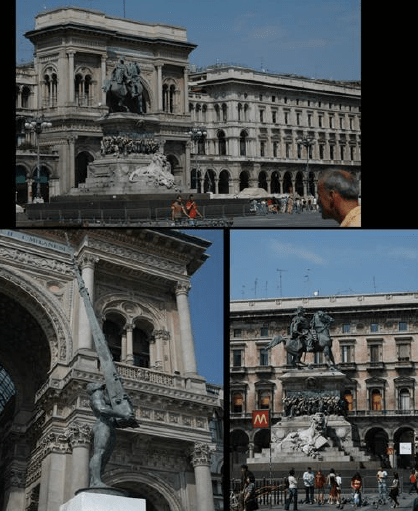
Milano is one of Italy’s largest, highly developed industrial and urban centers, situated in the province of Lombardy. It is not generally known for its architectural beauty or cultural history, compared to Florence, Rome, or Venice, but as the well-heeled (like my boss) know, it houses one of the most ancient churches in Italy, the Basilica of Sant Ambrogio, built around 300 AD. It was a burial place for the Roman martyrs.

Milan also has the Duomo, the world’s largest Gothic cathedral, second in size in Italy to Saint Peter’s Basilica in Rome. This grand building is a representation of high-tech architecture and construction in Europe, with methods developed to lift large stones to great heights. Construction of this monument began at the end of the 14th century, but the work took an astounding 4 centuries to complete, under Napoleon Bonaparte in 1805! All the time taken has resulted in a spectacle of white masonry of mammoth proportions.

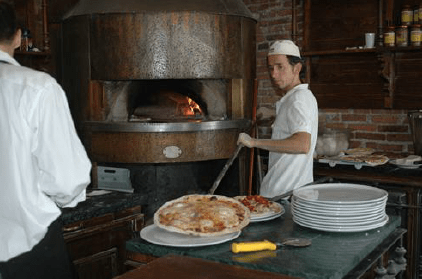
In the morning, before arriving at the Duomo we had a long stroll in the city. At around noon, when we were deliberating whether to start hunting for lunch, a decidedly special-looking Pizzeria called ‘Pizza Naturale’ caught our eyes. The walls of the eatery were darkened by smoke from the open charcoal oven from which the pizza-maker pulled out, as if by magic, pans of the most delicious Margaritas. Wine bottles were lined up on the antique wooden platforms over the counter.
The waitress greeted us with “Ciao” and a toothy smile and showed us a table just by the side of the road, not too far from the tram tracks. It was the right sort of place for Anirudh to pull out my camera and click with wild abandon at the passing pigeons, car tires, tram mechanisms, and even a pretty girl beside our table.
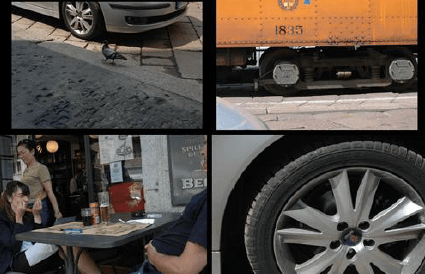
Photo 6. Anirudh’s avant-garde photography
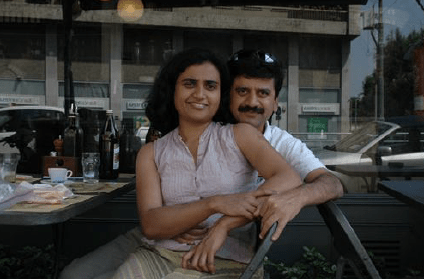
Just to show us that he is adept at conventional photography too (not unlike Picasso, who ignored his great skills at realism to paint abstract cubism), he took a picture of Vani and me.
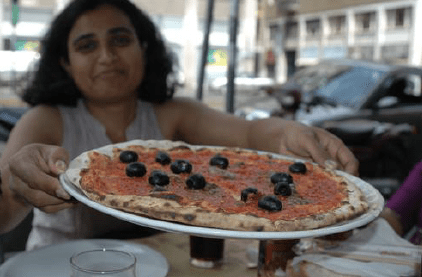
We ordered a couple of varieties of Pizza, an assortment of cold cuts (for the kids and me), fruit drinks, and a bottle of Chianti (for me). The Pizzas were some of the best we had eaten – that’s saying much, as Tuebingen, being close to Italy, has no small measure of Italian cuisine. Perhaps, we were just too hungry.
With stomachs full and limbs lethargic, we started walking towards Piazza Duoma (meaning urban open space, plaza, not “Pizza”). Vani peered at the shop windows displaying Italian leather shoes and bags -designer labels with “top” prices. Nayantara eyed plush toys and dolls (“hey, look at this Diddlina!”). Anirudh was curious about the passing trams (especially the one with a lady driver) and the road cleaning vehicles with their complex mechanisms, and immaculately dressed Italian Polizia. He made friends with every Italian mutt he met on the streets and took a multitude of pictures from the rear (he specializes in the retrospective) of people on the street, dogs and even his own furry puppy.
Amma, in the meanwhile, was busy taking in the alien surroudings, abound with strutting Italian signoras and signores, and Italian youth with their hairs colored the most shocking pink and green, tattoos in the most inconceivable places and nose rings of infinite variety (a surprise for Amma!), lazing by the fountains or leaning against the pillars, lip-locked and limbs entwined, as if in rapture of sensual bliss, not unlike the carvings of the Khajuraho temples or paintings depicting the Roman emperor Caligula’s orgies. Amma hurried past in a marked manner at an “embarrassing scene” here and looked askance at an untoward incident there. She observed quietly this hodge-podge of the old and the new that Italy throws up, of beautiful ancient buildings and urbane glass houses, of the fashionably dressed, sophisticated people here, and yet the most grungy youth there, and of the gilded shops on the one side and the littered alleys on the other side. If Paris was a “movable feast” for Hemingway, Italy appeared to be a bewildering puzzle to Amma.
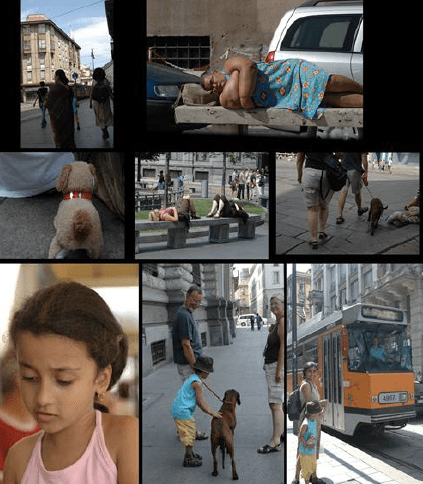
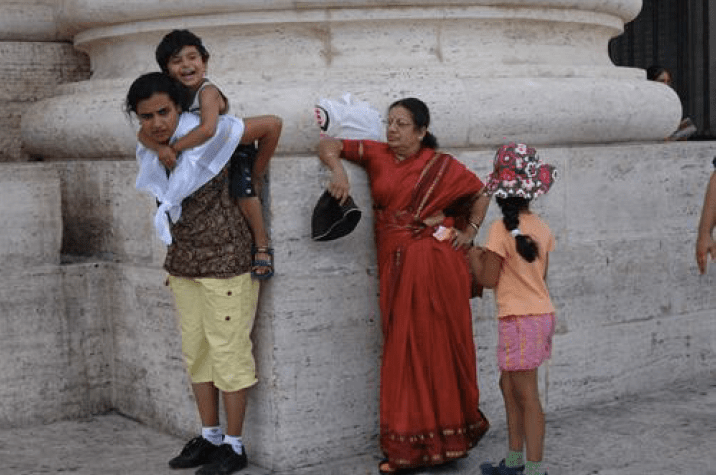
When we reached the Piazza Duomo, we gave our “singing” legs a bit of rest on the side-walks, watching the people feeding the pigeons and other people watching people feeding the pigeons, ate fresh fruits that we had bought on the way, while the kids vied for Janaki-ajji’s (Amma’s) attention. After this much needed respite involving a fair bit of lazing on the side walks, we were eager to look around again.

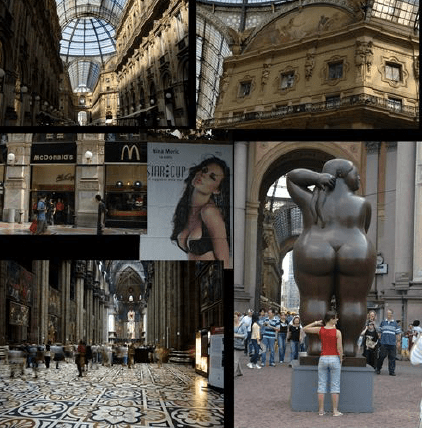
Milan is famous for its silk production, and as a fashion house and shopping center of the Lombardy region. It is also one of the world’s major financial and business centers. The city is the seat of the Italian Stock Exchange (the Borsa Italiano). Milan was included in a list of ten “Alpha world cities” in a major US economic report. Milan is also home to the Alfa Romeo car company. The Fiera Milano, the city’s Exhibition Center and Trade Fair complex, is the largest trade fair complex in the world. The Galleria Vittoria Emanuele in the Piazza Duomo, where we were presently, is reputed to be the world’s oldest shopping center. I realized, while walking around this high glass-ceilinged walkway lined with haute couture shops, posh boutiques, bejeweled galleries, bars and restaurants, and even a very chic McDonald’s, that many shopping centers around the world perhaps are modeled on it – the Queen Victoria upmarket building in Sydney, for one, springs to mind. I have fond memories of spending some enlivening time with my camera in front of a dark, voluptuous lady in her bare bums to return with some marvelously round images (one of which is below).
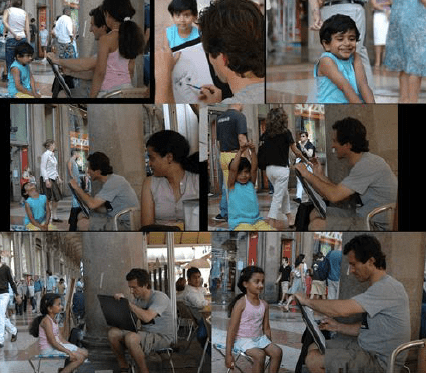
The Galleria Vittoria Emanuel is popular with budding painters, caricaturists and portrait artists who try to entice tourists to get their portraits drawn. One such artist pursued us and convinced us to draw portraits of Anirudh and Nayantara. We sat by an outdoor cafe, while he worked on Anirudh first. Needless to say, Anirudh was quite a challenge for the artist, and to be fair to Anirudh, it was in turn a tall order for him to take on the mantle of a model. Obviously, the artist had never drawn anybody who fidgeted, squirmed, made faces, gesticulated, talked incessantly, and wanted to see his portrait even as it was drawn. When it was all over, the Italian drew a big sigh of relief. After all the hard work with Anirudh, Nayantara turned out to be a willing and sincere model.
That evening, after a bit of rest at the hotel, I went out again to look for some Indian food for all of us, especially for Amma. I found an Indian restaurant, Gandhi, near our hotel. The friendly owner was a north Indian who had emigrated to Italy long ago. Because he spoke very little English (he spoke good Hindi, Italian, and German) and my Hindi is embarrassingly inadequate, we found ourselves in a bizarre situation: two Indians in an Indian restaurant in Italy talking to each other in German!
Early next morning, we took the fast, although expensive, Eurostar train (also called Pendolino) to Rome. Amma was quite impressed by the train’s look and wanted a picture taken in front of it. She had earlier taken a ride on the German high-speed ICE train on her arrival from India and appeared to enjoy such rides.
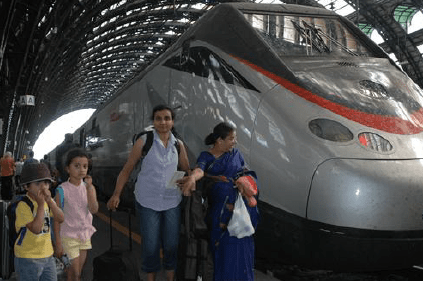
By the way, the world’s fastest trains are the French TGVs, which run regularly at 300 km/h on normal lines – but have the world record for speed on rails of 574.8 km/h, almost half the speed of sound! The Maglevs (Magnetic Levitation trains), technology developed by Germany and Japan, are purportedly the fastest (being able to reach 900km/h), with the trains being suspended and driven by magnetic force. The highest recorded speed by a Maglev is 581 km/h in Japan in 2003. The Intercity Expresses (ICEs) are the Siemens built high-speed German trains that run in Germany and Switzerland. In long stretches, such as between Frankfurt and Cologne they run at 300km/h. The ICE trains reportedly have 100% brand awareness in Germany – kids grow up playing with model ICE trains (complete with a mechanism). Our house owner builds model train layouts in his study and introduces a new ICE train every Christmas for his grandchildren’s pleasure. The next generation of high-speed trains in Europe promises luxury hotel facilities for overnight stays, baths, breakfast, and drop-off at the center of the destination city, and will give air travel a run for its money.
Traveling on trains in Europe is an experience of a kind that, when one is used to would find air travel hard to match – when comparing features such as quick connections from the city center, comfortable seating, dining-in, bistros with beer and espresso, not to mention the moving panorama of the beautiful landscape outside the window.
When we arrived in Rome, we were bemused to find that the Bread & Breakfast hotel we had booked on the internet did not exist at all, or more precisely, existed only virtually in cyberspace. We went up and down the Via Umberto Bianco road, presumably the site of this “castle in the air”, and even checked with the police who were lolling about in their high-tech vans at the corner, who serenely told us that this sort of thing happens all the time, implying that we’d better look for another hotel quickly. We bundled ourselves into a taxi and went back to the train station again, and after much asking around and looking at what appeared to be dwellings from the Hellenistic era, we finally came upon a rather expensive, ostentatiously named Hotel Palladium Palace for Euro 140 per day. After all that needless adventure, Amma and the kids tugging along sportingly amidst the confusion, we were happy to lounge the rest of the evening in the hotel room, ending the hard day with a delicious dose of pasta.
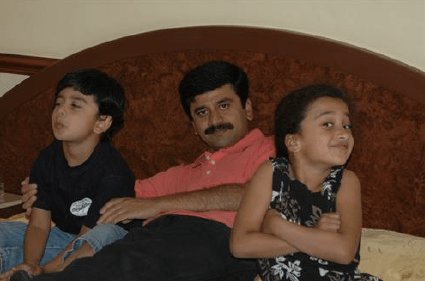
The next day, we all trooped into an open-top, double-decker tourist bus, arguably the best way to see Rome, as one has the flexibility to hop in and out at will, whenever and wherever one fancies. It also offers a bird’s-eye view, albeit a very low-flying one. Anyway, here we were, wobbling about and veering in and out of the wide avenues and narrow alleys of this monumentally beautiful ancient city, home to countless visionary ideas and the site of umpteen artistic innovations. I (and Vani alike) fell in love with this beauty at first sight, and vowed to come back again; preferably just the two of us – is that just wishful thinking?
The first thing that catches your eye, as you go around Rome, is the exuberance of fountains at every street corner. It is written somewhere that the ancient city had 212 fountains. The waters seem to spout from every conceivable crevice of both beautiful and grotesque creatures on earth.
The fountains, it is said, identify movement of water with the sense of life. The most magnificent is the Fountain of Trevi, with a chariot shaped like a shell drawn by seahorses. This work of art is relatively modern, dating from the 18th century. Legend has it that throwing a coin into the Trevi Fountain will ensure your return to Rome. By the way, Vani and I did not get a chance to throw a coin in the water.
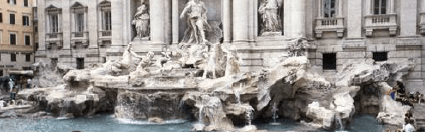
The fountain has become famous because of the movie “La Dolce Vita” in which the lead actress bathes in it! I will be surprised if Indian movie makers have not “Bollywoodized” this idea. I imagined a certain Sridhevi (I’m an old timer, you see) slithering about in the fountain waters in a transparent saree and a saucy song on her pouty lips while Rajnikant prances about on the sea horses with a certain disdain towards all this high art (“vandenda palakara adada…“).
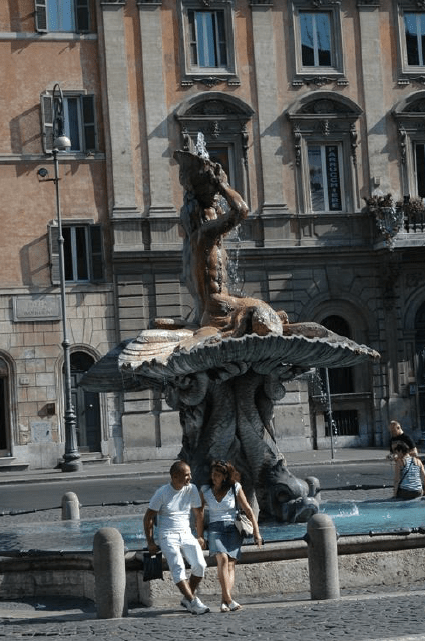
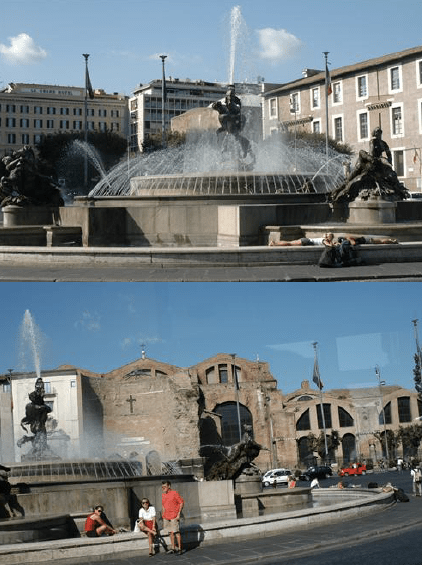
Our first stop was the Piazza Venezia, smack in the middle of Rome, a place of chaotic traffic, of herds of people getting in and out of vehicles to hurry to nearby tourist attractions such as the Campidoglio, the Forum, the Colosseum, and the Pantheon. The Piazza has an immense white marble monument (Il Vittorino) dedicated to King Victor Immanuel II, the first king of modern Italy. Here we spent much time walking around the various palaces: Palazzo Venezia – one of the oldest renaissance buildings in Rome (built during the beginning of the 15th century), Palazzo Generali (built in the 1900s) and Palazzo Bonaparte (where Napoleon’s mother stayed as a refugee after the fall of his empire), and visiting the museums of the Italian army which fought the world wars.

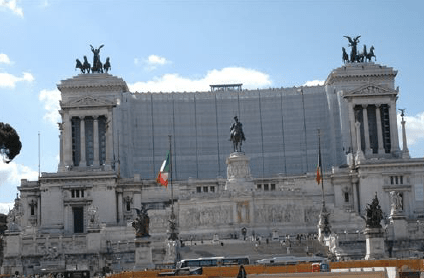
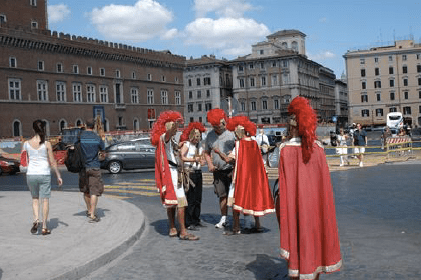
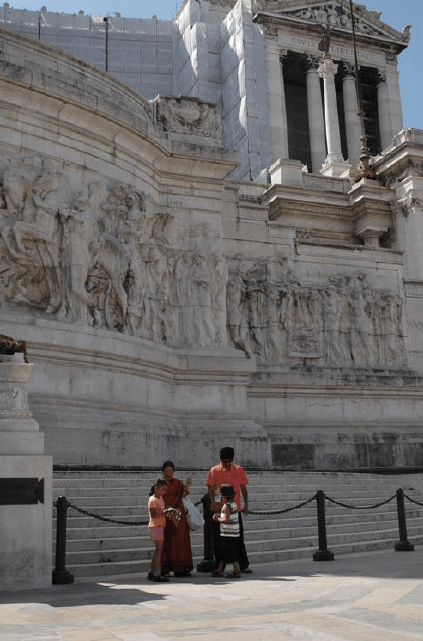

The Coliseum, originally named Flavian Amphitheatre, was said to be built for the glory of the emperor and the pleasure of the people. I read that it was commissioned in 72 AD and inaugurated by sacrificing 5000 animals. Until the middle of the first century, it was the sight of spectacular fights between gladiators (chosen from slaves, prisoners, and criminals) and wild animals such as elephants, lions, hippopotamuses – who all died for the vile joy of common people.
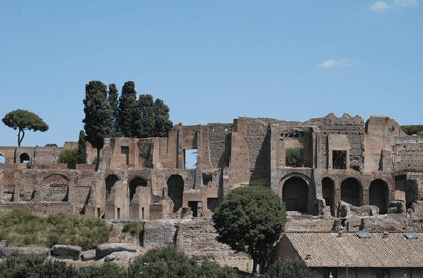
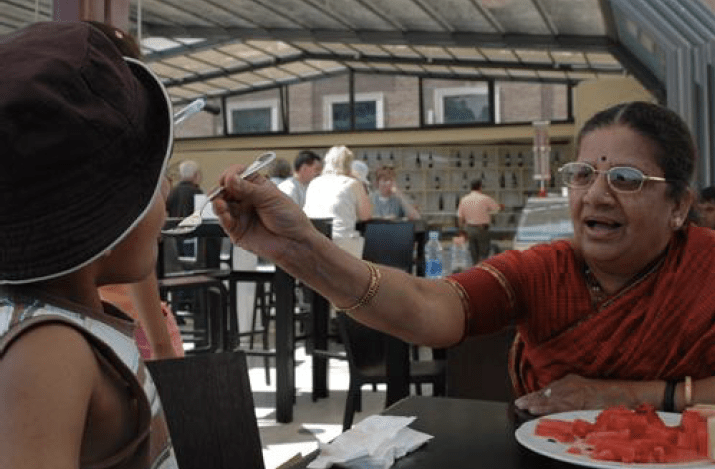
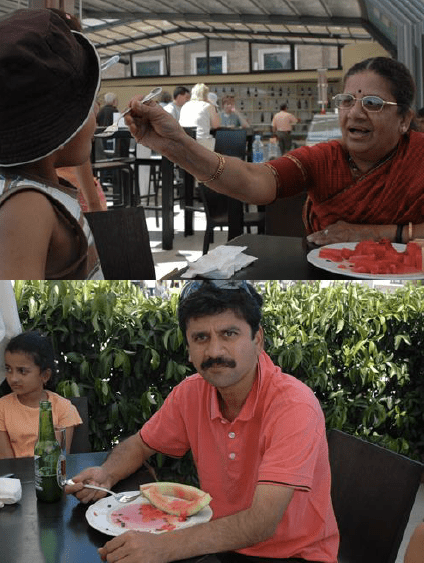
It was a hot day, and so before we got into another open-top bus, we cooled-off, on the terrace of Il Vittorino overlooking the great monuments of Rome, with some juicy pieces of watermelon and a bottle of cold beer for myself (an unlikely combination that thwarted the thirst with double effect – shows you have to go to Rome to find new cocktails).
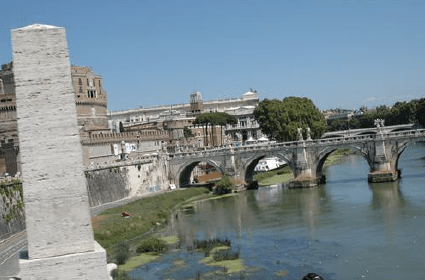
Many bridges cross the Tiber River, some dating back to ancient Rome. The oldest is the Ponte Sant’Angelo, which leads to Castello Sant’Angelo. I took a picture of this bridge from within our moving bus. The bridge was built in the 2nd century AD and is still in good working condition. Looking at these sturdy structures, Amma would often say that in the olden times they built things to stand the test of time – how many of our current buildings would be around for another hundred years, let alone a thousand years, would be a moot question.
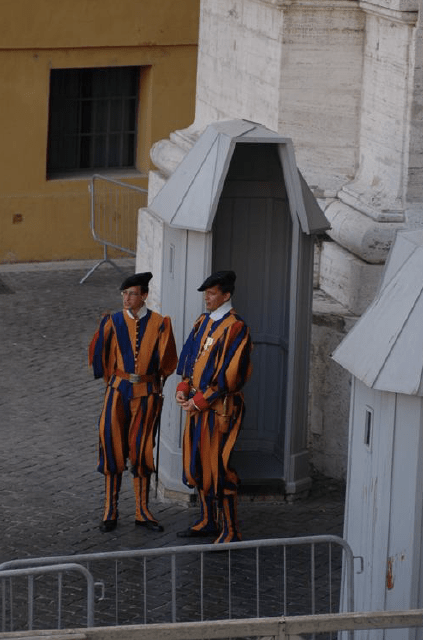
Our last stop for the day was the Vatican City – the smallest state in the world (0.44 km) and the most important basilica for Christians. Here, the Roman emperor (Caligula, of the orgy fame I had mentioned before) had built a circus, and the famous Saint Peter was martyred in the early part of 60 AD. The Vatican State was established during the Middle Ages, and it had extended to include most of Italy. It was, however, wiped out by the unification of Italy in 1870, but was again reinstated in the early part of the 20th century, and a kind of agreement for its coexistence was made by a treaty with the Italian state. The Vatican has its own police, army, and diplomats, not to forget the famous Swiss Guards with their colorful uniforms (see their photo below), supposedly designed by Michelangelo himself and unchanged for 5 centuries!

Piazza San Pietro (Saint Peter’s Square) has been the center of Christianity for more than thousand years now. The moment you enter the square you cannot help but be moved by the majesty and elegance of this huge place. It is designed as a perfect ellipse, described somewhere as being “harmoniously open to the heavens”.
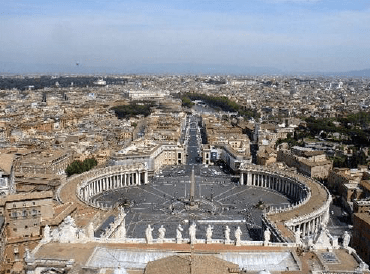
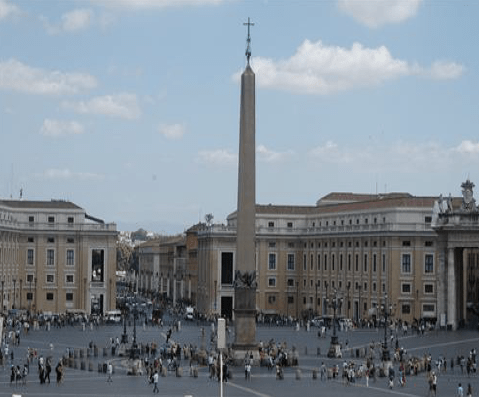
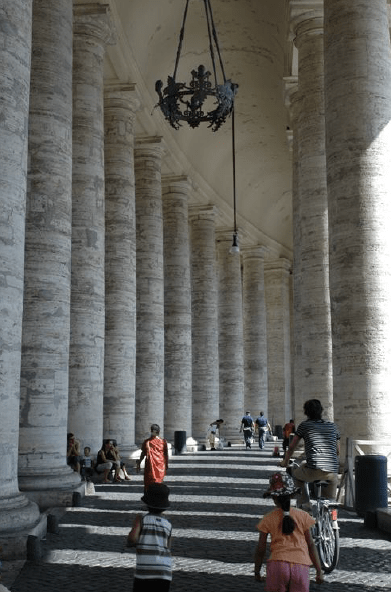
It contains close to 300 pillars (284, to be precise) arranged in four rows, topped by hundreds of statues of saints and martyrs of Christianity. As can be expected, there are fountains, of course, 2 great ones, and a very tall Egyptian obelisk (basically similar to the Garudu Kamba of South Indian temples in front of the entrance. For those who have read the Asterix and Obelix comics, the obelisk that Obelix carries should be quite familiar. An interesting architectural tidbit is that by standing between the two fountains on a slab, all the 284 pillars seem perfectly aligned and only the first column is visible! What do you say about this for the precision of engineering?
The jewel of St. Peter’s is the grandiose dome by Michelangelo, visible from all parts of the city. The dome is built on a drum with a series of windows, alternating triangular and square, separated by columns. One can climb to the dome by stairs or elevator. Inside the basilica, we are suddenly in the vast, cool interior of the largest Christian church. There are innumerable things to see. The most salient I can think of is the Pieta by Michelangelo, sculpted by the genius when he was only in his twenties, and it is the only work signed by the artist (see the photo below). In order to see more paintings, frescoes, and sculptures, one has to go to the
Vatican Museum. His other famous sculpture, David, is in Florence.


PIETA BY MICHAEL ANGELO AND OTHERS SCULPTURES IN THE CHURCH.
(Note: photos were taken in available light, which was spare light streaming in diffusely from the top of the dome, without flash but with long exposure)
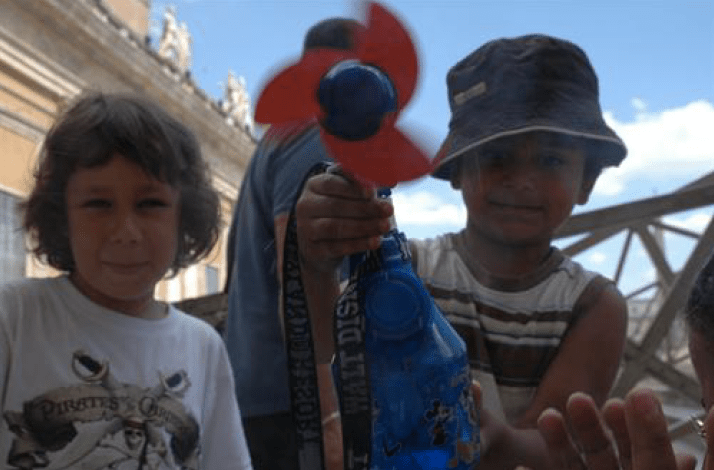
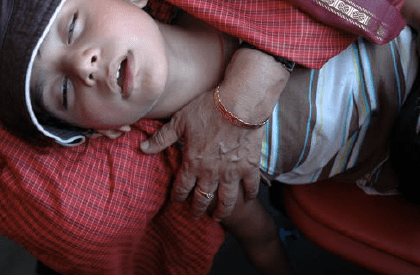
When we were tired from all the walking around, we drank cool water from the taps among the pillars of the Vatican. Anirudh made quick friends with another kid and played with his water-fan. When we boarded the bus again to return to our hotel, Anirudh fell asleep on the way on Amma’s lap, and a brat seemed to have thus metamorphosized suddenly into one of Michelangelo’s Angels!