

by Ranga Sitaram
Dedicated to Nayantara and Manu
for their indomitable spirit in our travels
The Gang
RameshaMVaniManu |
RajaKalpana |
AnilaDivya |
RangaNVaniNayantara |

And Their Travels
The North Island
Paihia
Bay of Islands
Auckland
Rotorua
Taupo
Paihia
When we arrived in Auckland from Singapore, we waited to meet Anila and Divya in the arrival lounge of the airport. They were to fly in from Queenstown after having completed their week’s trip of the south island first. Anila and Divya were full of stories of the south island. As soon as he had started his trip of New Zealand, Anila had enthusiastically started sending SMS messages to Ramesha in Singapore, advising this or that – to bring along an umbrella per family, to not bother too much about warm clothing as the weather was pleasant, to bring along power converters, so on and so forth. Now in person, he was uncontrollable.
Anila and Raja rented two cars from Hertz. We managed to squeeze in about 15 pieces of suitcases and bags, and 8 adults and infants with their child seats into the two cars somehow. The navigators, yours truly and Ramesha, with the drivers Raja and Anila, worked out the directions to Paihia on the road maps. We were then off on our way to Paihia.
The distance would be slightly over two hundred kilometers. Paihia is a coastal township situated to the north-east of Auckland, not far away from the northern tip of New Zealand, Cape Reinga. We were going to Paihia to stay there to visit the Bay of Islands, and if time permitted the township of Russell.
We would drive on the National Motorway #1, that would take us very close to the east coast of the north island via the towns and villages off the Hauraki Gulf, and the townships of Wellsford and Whangarei. For most of us the drive was an introduction to New Zealand’s opulent natural beauty. We would stop a couple of times, to admire the scenery and take pictures. Anila and Divya would remind us often that the scenery in the south island was even more impressive.
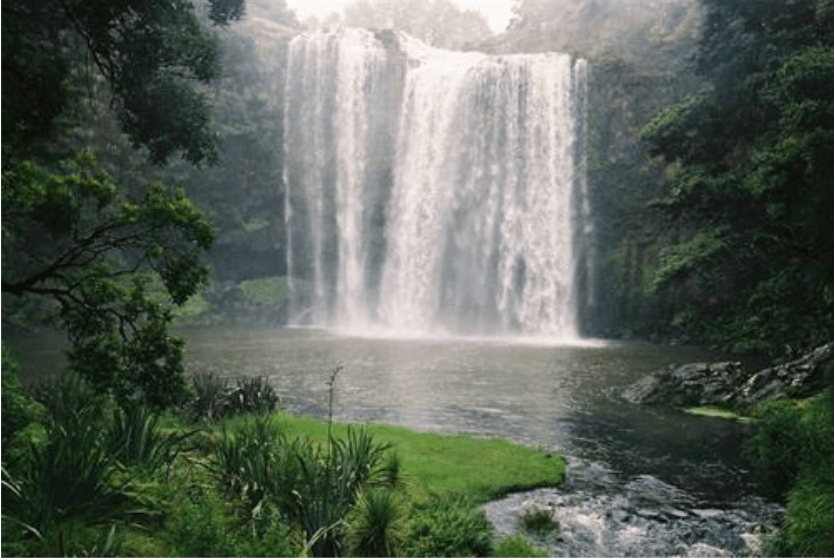
When we reached Whangarei, it was late evening. (On our return drive to Auckland two days later, we would visit the Whangarei Falls. It was drizzling as we walked down into the bushy valley where the water from the falls cascaded down into a pool below. Whangarei is New Zealand’s northernmost city. My guide book says, Whangarei has a huge deep water harbour with three separate port areas.)
As we neared Paihia, Raja wondered if our bookings would be still valid if we went in so late. I suggested we call them on the cellphone. NVani did so immediately. The lady in-charge at the hotel had just then cancelled our booking as we did not showup until then. She would have left for home in a few minutes. Phew! Anyway, she said she would revert our booking. She would place our room keys in an envelope near the hotel door. If Nvani had not called then, we would have been probably homeless that night.
We did not tell Anila and Ramesha about this, as they were in another car. We imagined we will act as if we knew nothing of this, and when they see the closed door of the hotel they will all be very anxious. Later we will show them the hidden keys and we would all laugh at their consternation. Kalpana even suggested that this might make a great story in my travelogue. However, when we went near the hotel entrance, the big envelope of keys was stuck to the door, for everybody to see. What a let down!
We had packed some tasty fried rice and noodles from a Chinese restaurant on the way. The gang got together in our room, for dinner, and to hatch some travel plans for the morrow.
The next day, after breakfast, we left the hotel to take a cruise to the Bay of Islands. Most of the gang was enthusiastically dressed in blue floral Hawaii shirts.
Paihia is the main tourist centre in the Bay of Islands. It is a convenient base for cruises and other activities. It has a wide range of motels, hotels, restaurants, cafes, shops and cruise operators. We bought tickets in the King’s Cruise for a boat trip to Bay of Islands and back. A cruise like this is a good way to see the islands and places of interest such as the site where James Cook landed in the 18th century.
There is also one island in the bay where the Waitangi Treaty was initiated. The treaty, as the guide book says, was signed in 1840 AD to assign sovereignty over the country over to the British Crown. The treaty was written in English with a rough translation to Maori. Interestingly, Maoris had no such concept – of ownership and sovereignty – and so the treaty could not be completely translated. The British did teach the world some really wicked concepts.
The boat trip was very exciting for some and a bit hard to handle (sea sickness) for others in the group. The sea was stormy and there was a cold gale. The boat rolled and pitched a lot. Some couples took this opportunity to have a romantic interlude on the deck in the manner of the famous scene in the movie Titanic. Most of us, except those with the kids, were sitting on the deck to experience the tumultuous journey.
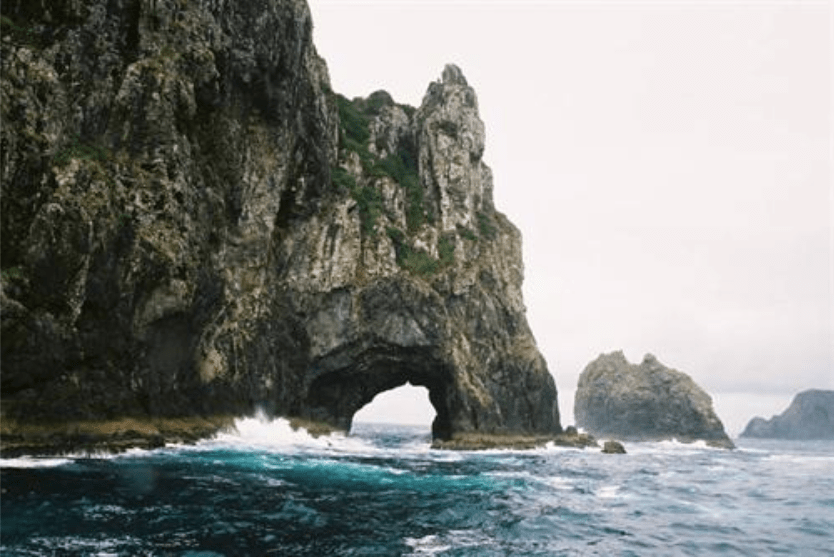
Ramesha was disappointed that our boat did not go through the Hole in the Rock at Cape Brett. I found out later that it was cancelled because of the bad weather conditions. We saw a number of dolphins visit and play around our boat.
After the cruise, we decided to go and buy some groceries to cook some Rice and Rasam. We went intto an Indian shop, not unlike Singapore’s Mama Shops. The shop owner was a Gujarati who had lived in Paihia for many years. We bought rice, tomatoes, onions, salt and sundry.
Raja and I thought of starting the trip on a good note, by having a minor binge. We drove to a liquor store and bought a couple of wine bottles, chips, salsa, and local cigars too. Back in the hotel we had a good time eating and drinking. I had plans of initiating everybody in the group to cigar smoking. In the cool breeze of the night outside, gents and ladies alike shared a cigar. Ramesha took to it as if he had been smoking for a while. He dragged on it with the pleasure. We then had a leisurely stroll to the downtown and brought back big bowls of ice-cream from a restaurant.
The next day we gave up plans of going to Russell as there was not enough time. Instead, we drove back to Auckland.
Auckland
Auckland is a gateway to New Zealand for most international travelers. It is the country’s largest and most cosmopolitan city. Out of over 4 million people of New Zealand, 1 million live in Auckland.
On the second day we visited Mt Eden. We parked our cars near the entrance to the park at the base of Mt Eden. We had noticed an Indian restaurant by name Sitara nearby. We went there for our brunch. We had a heavy meal of Rotis, Channa, Dhal and Rice, washed down with Masala Tea.
I particularly remember the difficult time I had changing Nayantara’s diaper in the narrow confines of the toilet in the restaurant. There was no facility for changing diapers there. The floor was wet. I had to hold her up to wipe her bottom, while she squirmed around a lot to get down. There was no dustbin to dispose the wipes and diaper anywhere. I packed up the not-so-fragrant remains into a nice bundle and left it there.
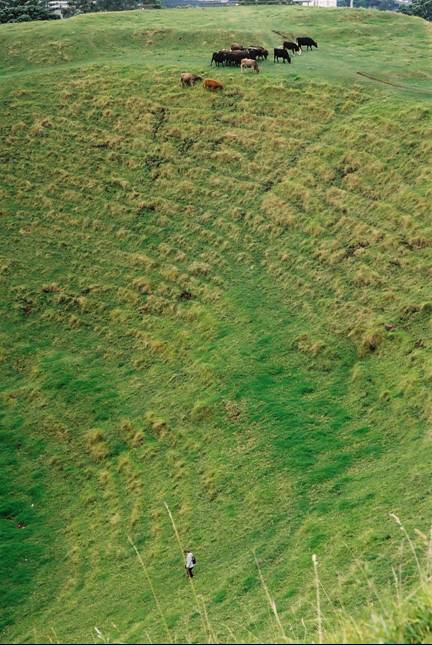
Mt Eden is Auckland’s highest volcanic cone. My guide book says it is about 196 m tall. It is a good place to go for a panaromic view of the city. When we reached the summit, we had a good view of the city buildings, the isthmus and the harbour from the top.

It was hard to climb with the strollers. Ramesha and MVani kindly agreed to stay back at the park to look after Manu and Nayantara, so that Nvani and I could climb up with Raja and Anila families. The trek up the mount was a little strenuous in the beginning after the heavy lunch, but soon became comfortable. It was very pleasant in the cool air and the green surroundings. Anila and Divya, and NVani and I climbed down the huge crater, while Raja and Kalpana watched from the top. We admired the spirit of Aucklanders climbing in and out of the crater with their small kids. Later, we drove up to show Ramesha and MVani the crater, before heading back to our hotel.
Rotorua
On the third day of our stay in Auckland, we left early in the day on a coach journey to Rotorua. The coach took the National Motorway #1 in the southward direction. We would drive via Manukau, the city of Hamilton and finally Rotorua. Our driver was a tall, hefty New Zealander who was to drive us until the Waitamo Caves. Afer that, the coach would be taken over by another driver.
My guide book says that the Maoris knew the existence of the caves for a long time. Europeans became aware of the glow-worms and limestone features some hundred years ago. The village of Waitamo has been a tourist attraction since then. We were shown around by guide inside who explained to us the million years process of the formation of limestone deposits in various forms, as layers of flat rock, and as sharp and conical stalactite formations. Finally, a small boat carried us through the most awe-inspiring part of the cave. A silent journey along an underground river with millions of glow worms sparkling on the walls and ceilings. We held our breaths in wonderment. Nayantara was, however, fast asleep in my lap, and that helped in a way.
The driver who took over at Waitamo was a thin, angular middle aged Irishman. He was smoking with long deep drags on his cigarette when I met him first outside the coach. He spoke in flowery, elaborate English. He pulled, pushed, stretched, split and merged his words in a plethora of ways to dramatic effect. As he drove along, he gave us interesting trivia about the surrounding places, peppered with dry humor. Here’s an excerpt from his repartee:
“We are going to go Strai-GHT throughhh, non-stop to ROTOrua city. You are going to see a liTTle bit of change in the scenery. We are going to go away from low-lying dairy farming country to areas which are hilly. It Rrreallly is a BbeaUUtiful drive. As I mentioned earlier on, ROTOrua city is very much the cultural centre for the indeginous people, the Maori people. They make up about 45% of the population of the city. So, I do tThhink it would be rRAAather pleasant if we were able to address them in their own language. SO, in a minute or two we are going to hear a little bit of Maori. HoweVER, there is a VeRRY impOrtant thing that you need to do first. And that is to make sure you get the pronunciation of the name of the city CoRReCCTT. It is called Rotorua. R-O-T-O-R-U-A…..”
“There is only 22 Sqm difference between the areas of New Zealand and United Kingdom. The population of New Zealand is 3.6 million. The population of United Kingdom of the same size is 60 million. The population of metropolitan London alone is 3 tTimes the enTTiRe population of New Zealand. And also, situated on the west coast of this country is a tTiiNy neighbour of ours, called AustrAAalia (everybody laughs loudly at this point). And it is of the same size as the US of A. Population of AustrAAlia is 18.8 million. Population of USA of the same area is 280 million! And, that’s a little bit of tToTTally useLESS information for you (everybody laughs even harder)”.
Rotorua is at the heart of the volcanic plateau. It is a popular and commercialized tourist resort. People come in busloads to visit a range of attractions. The city and its surroundings have a series of spouting geysers, hissing fumes, bubbling pools of mud and sulphur; all of them geothermal phenomena emitting hydrogen sulphide that gives the city a pungent odor. Despite the odor most of us liked the city. Kalpana said, she liked the city best among all the towns and cities we visited in New Zealand.
Rotorua is situated on a lake by the same name. The city was developed as a spa town, as my guide book suggests.
We stayed in Rotorua for 3 days. We had rented two cars. A red, 4 wheel drive which Raja drove, with me beside him as the navigator, and Kalpana and NVani at the back with Nayantara in the child seat. Raja was very excited driving the spacious and powerful 4WD. Anila had rented a white Ford automatic in which Ramesha and Divya alternated as navigators, and Vani and Manu travelled at the back.
On the second day, we visited the Rainbow Springs and the adjoining Rainbow farms in the morning. Rainbow Springs are the largest trout springs in the region.
Rainbow Springs is positioned to attract visitors, with facilities including a souvenir shop, photo processing lab, and a restaurant. Beside the trout springs is a small zoo area that had animals such as deer, dwarf horses and wild pigs. I took some pictures of of Nayantara beside a dwarf horse she was fascinated about.
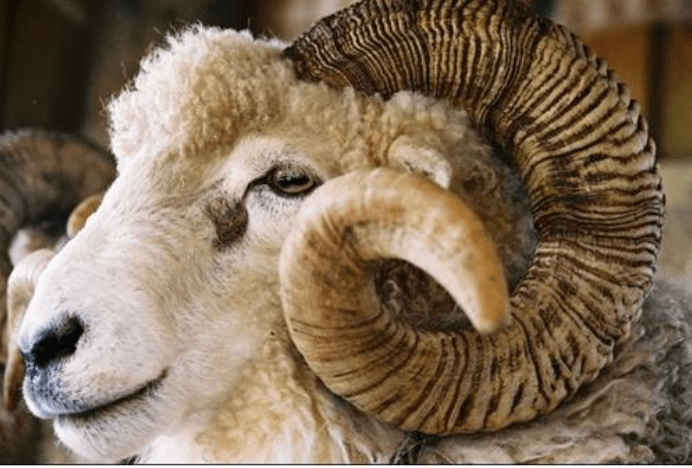
Across the road and linked by a tunnel is the rainbow farm. Here a huge barn is the setting for regular shows featuring sheep shearing, sheep dog mustering, an interesting and loud, staged sheep auction, and plenty of “agricultural entertainment”. The sheep shearing was demonstrated by a sturdy man, with fantastic side burns, and a tall lithe farm girl. Anila took part in one of the features with the farm bull, and Kalpana volunteered to feed milk to the cute lambs. After the show, I showed Nayantara some farm animals, including a majestically horned Merino ram, and two farm dogs of breeds, noisy sheep dog and strong-eye heading dog.
In the afternoon, we went to Whakarewarewa, also just called Whaka. It is another thermal area, which features boiling mud pools, silica terraces and steam vents. Whaka is inhabited by many Maori families. It also houses the Maori Arts and Crafts Institute which trains young craftpeople in the old Maori carving and other art forms. There is a Maori village with daily cultural shows.
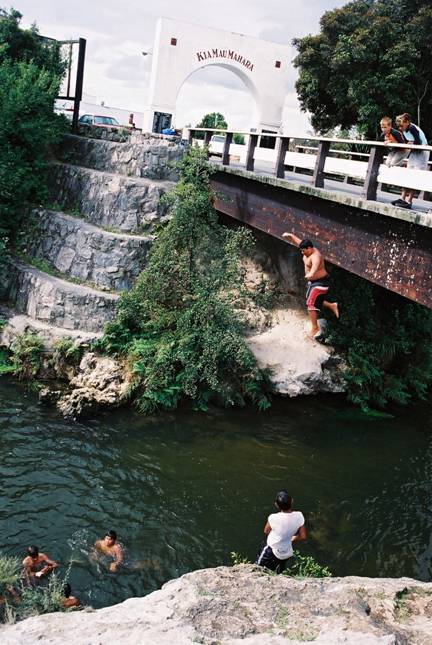
When we entered we saw a small pool of water on the left, not unlike the wells we see in Indian villages. There were young boys and girls swimming in the well. Boys frolicked by jumping off the ledges from the top of the well into the waters below.
Upon paying the entrance fee, we were sent with a Maori guide who took us around the Whaka explaining to us the steam vents, hot pools and other thermal phenomena. He showed us the Maori form of cooking in the thermal pool, called Hangi. Somebody was actually cooking sweet corn by dipping a few of them in a thermal pool, tied in a cloth. We went to a wood carving centre and got bored by the unending philosophizing about the wood carvings by another guide. A few of us in the gang discussed about the great potential that India and its culture has for tourism. We were a bit sad about how it lags behind other countries in that department.
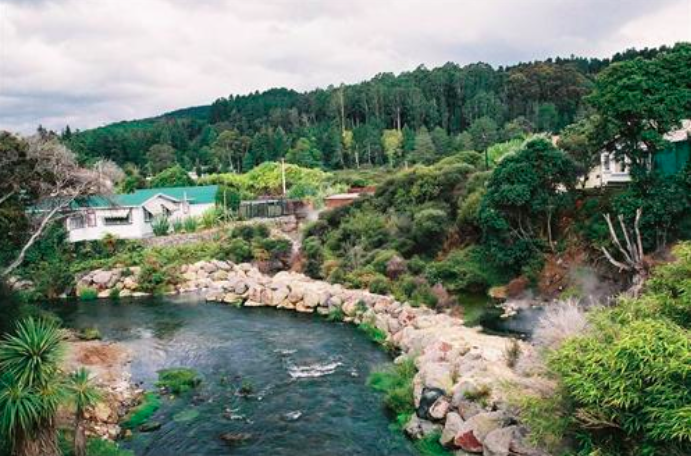
In the late afternoon, we went to the Polynesian Spa. The spa contains a number of different mineral pools and hot springs maintained at different temperatures. Anila, Raja and I chose the mineral pools. There were 4 mineral pools in the open, with the water supposedly being maintained at different temperature in each pool by the heating system. The attendant suggested us to start with a pool with the minimum temperature at 38 C. The temperature of the adjoining pools gradually increased. When we tried to get into the first pool, we found it absolutely hot, obviously much more than the 38 C. Anila, however, was quite comfortable in that heat. Thick skinned! Later the attendant came back and said there was some problem with the temperature control in the pool. It had gone over 45 C! We were joking with Anila to check if his anatomical parts were still intact.
Divya and Kalpana resorted to a private spa pool. Ramesha as is his wont took up a massage treatment called ‘Aix Massage’ administered, as he later described, with oils first and then and jets of hot water later. The two Vanis had decided to stay back in the hotel to give the kids a breather.
When we came out of the spa we were all so famished that we decided to immediately go for dinner. A Japanese girl in the counter suggested the Fish Pot restaurant for seafood. Anila impressed her with his smattering of Japanese, such as Arigato Gosamasai, and so forth.
Interestingly, we found out that it is illegal to sell trout food in the restaurants in New Zealand. Ignorant of this caveat, we went to the Fish Pot, with an urge to eat smoked trout. The waitress enlightened us that only visitors who bring their own trout they fished would be served with trout on the premises. The restaurant itself does not carry or serve any trout. We were disappointed. We were in no position to fish trout then. All the same, we ate some delicious seafood washed down by a bottle of Pinot Noir. I had an entrée of sea bass cooked with herbs and sauces.

On the third day, we visited the Wai-o-tapu Thermal Wonderland in the morning. It is a major thermal zone, with blowholes and boiling mud pools. There are colorful mineral deposits appositely named Artist’s Palette and Champagne Pool. There are large sulphurous craters. And then there is this Lady Knox Geyser. The Geyser is primed at 10:15 AM daily by soap water so that it can foam out in front of all the paid visitors. It is a natural phenomenon that is, somewhat perplexingly for us, artificially induced. This was not acceptable to most of us, and we felt cheated. One of us, I guess it was Anila, named it enema for the way soap is used to induce the geyser to act.
In the afternoon, we drove to the Huka Falls. The falls plunges to about 10m with a great body of foaming, blue green waters. From a view-point on the east, it is truly a spectacle. One of the attractions was the jet boating in the Waikato River. Ramesha and NVani tried the jet boat first, and came back completely enthralled. Ramesha was very sure that we should all try it. Raja and I, in the meanwhile, tried some drives in the golf driving range in the Frog Pool. We then went on the jet boat ride. The jet boat driver was very able, and he demonstrated his finely honed skill in skimming the water surface at a high speed, and at 360 degree turns and twists. It started raining during the later part of the ride. Rain water falling on our faces at such a high speed of the boat caused a painful pin pricking effect.
In the evening, we drove to Taupo City, and had dinner at an Indian Restaurant close to the lake Taupo. When we finished dinner, it was dark and time for us to start our drive back to Rotorua.
The next day, all of us except Anila and Divya were to fly to the South Island, to Queenstown. Anila and Divya were on the last leg of their trip in New Zealand, having started their trip a week earlier than ours. We bid a reluctant farewell. We would miss their company in rest of our trip in New Zealand.
The South Island
Queenstown
Milford Sound
Wanaka
Christchurch
Arthur’s Pass
Pear Drop Inn Farmstay
Queenstown and the Fiordlands
Queenstown is probably South Island’s liveliest adventure centre. It’s a year-round resort, with skiing activities in the winter and a whole host of summer activities in the lakes, mountains and rivers of the region, including jet boating, bungee jumping, trekking, fishing to name a few.
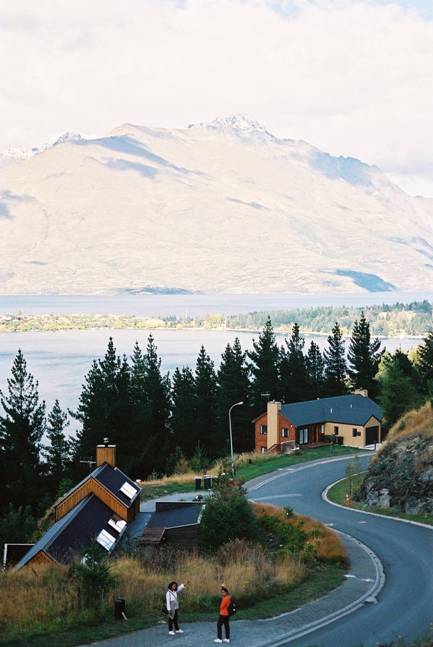
We stayed in the Sherwood Manor, situated on a hillock, overlooking the Remarkable Ranges and the lake Wakatipu. When we woke up in the mornings, I would come out with Nayantara to see how much snow-capped the Remarkables were on that day. For us people who rarely get to see mountains in Singapore, let alone snow-capped ones, it was a sight of singular beauty.
The hotel had two rows of red tile roofed suites, each suite consisting of a living room, well equipped kitchen, bedroom, bathroom and toilet. There was a small swimming pool in the middle of the hotel with a rim of flowering plants around it.
Milford Sound
On the second day of our stay at Queenstown, we left early in the morning for a day’s package trip to Milford Sound in a coach. The journey to Milford Sound from Queenstown takes about 5 hours by coach with intermediate stops for refreshments, most notably at the beautiful lake town of Te Anau. Our driver was a fast talking guide who was full of information about the flora, fauna, the history, and Maori stories as he drove along. He became unpopular among our group, because of his non-stop talking with a thick New Zealand accent that made it difficult to catch what he was saying, yet difficult to ignore him as the sound was too loud to doze off. He was certainly no match as an orator to the flowery language, the wit and humour of the Irish driver who drove us from Auckland to Rotorua. Still I found the present driver interesting with titbits of trivia.
He droned on at length about the Maori legend of the creation lake Wakatipu. He gave us details about the sheep farming trade. With much detail. Currently, on the average, he said, sheep cost ($65 per sheep). Sheep are grazed by moving them from one plot of grassland to another each day in a cycle of 60 days – to allow the grass to grow back in time. Sheep are sheared by contractors who are hired by farms. Some larger farms on the other hand may carry out shearing on their own. It takes about 5 years to master the craft of sheep shearing. Sheep shearing competitions are held regularly. Very good quality wool are obtained from a breed of sheep called the Merino. There are many breeds, some indigenous, and some introduced by Europeans. Sheep are bred for both wool and meat. Cross-breeding has produced sheep for different areas, and a wide variety of sheep is now farmed. So on and so forth.
He talked about Bungee Jumping. Bungee jumping has been around for many centuries. In Vanuatu, it was traditionally part of the initiation ceremony to manhood. Young men plunged from headlong from bamboo structures by stout vines attached to their feet. Inspired by this, New Zealand’s A.J. Hackett devised a safe, controlled method for jumping using the same principles. They say all it takes is willpower. The oldest bungee-jumper so far was a 90-year old from Normandy. At one stage, Hackett’s free jumps to anyone who went nude. Demand was so great that the offer was to be discontinued!
He talked about the extinct Moa, a flightless bird like the Ostrich, upto four metres tall. They were wiped out by hunting by the Maoris. Early Maoris were called Moa hunters.
He talked about Kea, the native parrot. He talked about the Takahe, a Fiordland native, with bright blue and green plumage. Takahe were thought to be extinct until they were rediscovered 50 years ago. He talked about the famous nocturnal Kiwi. Kiwi is a relative of Australia’s Emu. The Kiwi thrived when there were no mammals to threaten it. It has a highly developed sense of smell, and it is the only bird with externally developed nostrils at the end of its bill, with which it sniffs out its food below the ground. He talked about the possum. He talked about the change in the vegetation and foliage as we moved closer to the Fiordland.
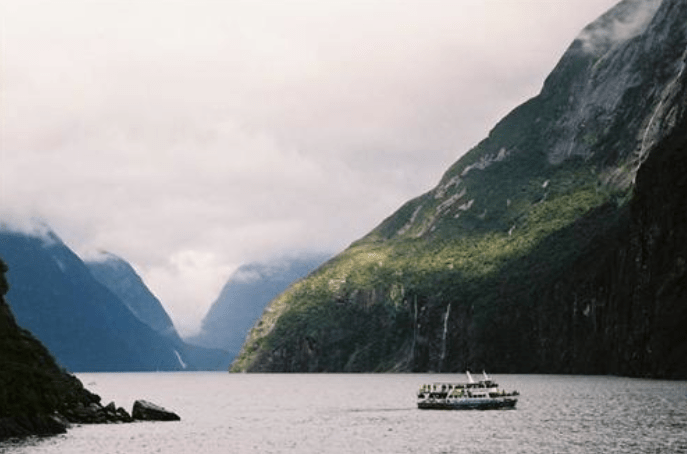
Fiordland is a rugged wilderness where coastal fiords allow the Tasman Sea to penetrate deep into the hills and mountains. The glacial lake of Te Anau is one example of a number of inland lakes. There are 14 fiords in the Fiordland National Park, New Zealand’s largest national park. Milford Sound is the most popular of them all, followed by Doubtful Sound. Milford Sound is surrounded by steep, forest-clad cliffs with many waterfalls dropping vertically into the sound (fiord). Milford Sound has the highest average rainfall in the country, and it is at heavy rains these falls are most spectacular.
It was raining as we got into one of the boats from the Red Boat Cruises. We had paid a hefty sum of $190 for this cruise with lunch on board. As we boarded, a girl darted infront of us and quickly took a snap of each family entering. We found ourselves a table and sofa for 6 of us and 2 infants. We were very hungry. We filled our plates with pasta, rice, steamed vegetables, bread, butter, fruits and ice cream. Raja and I got some chicken and lamb curry too, with a bottle of beer each. We had lunch, as the cruise boat moved towards where the fiord meet the Tasman Sea with mountains, peaks and waterfalls all around us. When we finished lunch, some of us went up to the top to take video and pictures. Manu was a little bothered here for some reason, and was blowing his famous “siron” in a continual melancholic vain. Ramesha found some similarity between his sound, and the the constant sound emanating from the rain, the falls and buzz all around. He re-christened Manu as Milford Sound.
As we returned, some of us felt that the $190 per person for the trip was a little too much. We had too high an expectation of Milford Sound from all the reading and hearing about it, and the actual visit did not satisfy.
Our feeling of the trip to Milford Sound was made worse by attitude of some of the fellow passengers in the coach, who seemed intolerant of the kids. That particular day, Nayantara and Manu were a little under the weather, probably because of the long journey, and they did make some noise. There was one American Tourist who was sitting in front of us who frowned and furrowed his brows constantly, looking back at us and the kids. He was obviously not happy with the noise coming from the back. Later, after a stop at Te Anau, I noticed he went and complained to the driver, and changed over to a seat in the front far away from us.
Raja was unhappy about a lady who used the coach toilet. When she came out after what seemed a big job, there was a gust of foul smelling air that filled the coach. He swore at her with some particularly bitter but funny Kannada remarks that regaled us all.
Lake Wanaka
Raja’s colleague, Bob, had suggested that he should on no account miss visiting the lake. Raja tells me that Bob is a great cross country cyclist, adventurer and travel enthusiast, who globe-trotts frequently on one his cycling, running, skiing or camping jaunts. Bob had camped on the Wanaka lake-front, and had apparently fallen in love with the idyllic setting. And so, it was a given that we would visit the lake, which we did on the third day of our stay in Queenstown.
We tried hard to rent an 8-seat car for the trip. We visited almost all the car rental agencies in the downtown of Queenstown in vain. Apparently, cars were all booked up very much in advance. We had to then book one of the daily sightseeing tours to Wanaka. The tour van would leave in the afternoon and return in the evening.
We went to the Little India Restaurant to pack some lunch to take back to the hotel to eat before setting off on the tour. The hotel manager was one Mr. Josh, a Malayali. He said he was from Bangalore, and was working in the restaurant for the past two years. He told us that their restaurant is the best in Queenstown. It is now a common practice for Bollywood and other south Indian movies to shoot song and dance sequences abroad. New Zealand and especially Queenstown is at top of the list of favourite locations. The most famous Bollywood movie shot here, as cited to me by my wife who is better informed in these matters, is Kahona Pyar Hai, starring that poster boy and heart throb of Indian girls and married woman alike, Hrithik Roshan. Josh was boasting that Indian film stars and actors, who are on location shooting in Queenstown pack breakfast, lunch and dinner from this restaurant, and not only that, they would come back to eat in the restaurant if they have time. Josh said that Jeetendra’s (the former Hindi film star) son, and Hemamalini’s (the former Hindi film heroine) daughter were here recently.
We ordered rice, and two types of Dhal dishes, and Papadums to be packed. Josh billed us a hefty sum of about $60 for this simple and small fare. Ramesha was particularly angry about this exorbitant pricing. He would come back from Wanaka in the evening to look at our expenditure on the trip until now. Some of us would be surprised and shocked on how much we had spent, especially over and over again on unsatisfactory yet expensive Indian food. We never seemed to learn.
Wanaka is about one and half hours drive from Queenstown over undulating, mountainous terrain with deep valleys and lakes on either side. The van was quite filled before we got in, by a few young girls on some sport around Wanaka. We sat beside a plump, red cheeked young lady, who interested Nayantara for some reason. Nayantara would look and babble something at her from time to time apparently trying to catch her attention and make friends with her. The driver was a middle-aged lady who was carrying some heavy boxes to Wanaka. She kept quite for most part of the journey, except a couple of times when she pointed out something of interest to us. After an hour, we came upon a forgotten township, apparently quite a place in the hay days of gold mining in the Queenstown area. She showed us the oldest hotel (I forget the name) in New Zealand, at that time serving minors, now still open to visitors and boarders. When we reached at about 1:30 PM, we were dropped near the information centre by the side of the lake.
Wanaka seemed a peaceful township, situated at the southern end of Lake Wanaka. It seemed a relaxed, not-so-commercialized, and sparsely populated place. Visitors come here to fish and boat on the lake, walk in the nearby national park.
The lake is a beautiful blue expanse of water fringed by broad, grassy park lined with many trees (poplars and willows as I was told), with barbecue areas beside the beach. We settled in the grass beside the lake whereupon a number of ducks and geese came by and delighted Nayantara and Manu. It was for me a perfect setting for a long, rejuvenating and healthful walk. But the Vanis wanted to take a look at the Puzzling World first. Reluctantly I agreed. When I asked directions for Puzzling World, the lady at the information centre had said it was a 10 minute walk. It turned out be a much longer walk. Some of us were a little angry for having been asked to walk that distance with the kids’ prams, especially on a difficult terrain. I was a little forceful, not relenting to give up the walking. With a bit of hardship to the ladies and to Ramesha, we finally reached the Puzzling World.
Puzzling World, as the name aptly suggests, is a place of many puzzles, illusions and tricks. It was the originator of the ‘maze craze’ which saw many imitators all over New Zealand. We did not do the maze for want of time or interest. But, all of us had fun with the hologram gallery, the tilting house, and the funny toilet where I took pictures of MVani and Kalpana posing to be part of a communal, open toilet, in a setting reminiscent of ancient Greek bath houses and toilets. I thought Kalpana was particularly good at acting as if she was constipated, with her contorted face and stressed expression. I realized, however, that this could have come naturally to her, what with a period of difficult bowel movements she suffered in the early part of our trip in Paihia and Rotorua, to overcome which she had to eat a number of bananas everyday.
Queenstown Environs

On the penultimate day of our stay there, we went walking up further on the hillock we were on, from the back of the hotel. As we walked we came upon some spectacular views of the mountain ranges, the lake, the town and beyond. There were many bungalows and pretty houses on the hillock. We were envious of the people who lived there. As we watched the fantastic houses and gardens around us, the conversation somehow turned to how difficult it is to be able to live such a life in Singapore, in spite of working so hard. A long dissertation was done on the topic.
In the evening, the ladies prepared a simple yet homely meal of Rice and Rasam, with Papadum done over the cooking gas flame. We also had chick peas curry brought from Bombay Restaurant from downtown Queenstown. I swigged about 3 bottles of Stein Lager. Nayantara and Manu were in tremendous spirits, having found the rare freedom to move about, away from the constant car, boat, bus, train or plane journeys that they had to put up with in the trip.
Kudos to them, they were such darlings all along, adapting to the cold, the wind, the constant journeys, the repeated change of hotels, the inconsistent food, the cooped up feeling while travelling, and the loss of mobility. It was more difficult for us adults to cope with the changes, and it showed towards the end of the trip, in the way we were more cranky than the kids themselves. This evening they played with abandon, playing hide and seek, chasing each other, pulling at each other, screaming, laughing, gesticulating and making merry, while I took a long video of their pranks, having nothing else to do.
On the last day of our stay, we had decided to stroll in the Queenstown downtown, before our scheduled flights to Christchurch at 4 PM. NVani liked the downtown a lot for its pretty streets, with colorfully flowered potted plants hung in front of the varied shops. She longingly talks about it even now.
At the heart of the town are the traffic-free streets of Mall Street and Church Street, running down to the lake’s edge and parallel to the Shotover Street, where you will find the visitor information centre, car rentals and such. There is also an Indian restaurant by name Faiza on the Shotover Street. At the end of the street is the wharf, with upmarket boutiques, wine bars and restaurants. There was an outdoors fare going on at the lake front, with shops showing clay figurines (some of which NVani bought), ceramic ware, linen, wooden stuff, and so forth. I ate a delicious sandwich of barbequed sausage and onions with mustard sauce, watching a live band of a duo, with the lady singing a melodious love ballad and the man playing some Maori influenced music. Ramesha wanted to taste the sandwich, but recoiled when he saw the meat in the sausage. The lake front is truly a lively place of assorted activities. Jet boating trips in the Shotover River start here. I gave Nayantara her lunch of cereals, showing her ducks and muted swans in the lake.
I bought a print of a beautiful water colour painting of a scene in the changing room of a cricket club, titled Night Watch Man, for $29. The Vanis were, in the meanwhile, buying T-Shirts for our group to commemorate our excellent trip. Ramesha secretely showed me the video that MVani had taken of an improptu dance by a very young Indian Heroine, Shreya, to the hauntigly melodious tune played by a busker on the street on his flute. (Apparently MVani had instructed him not to show until it was supposed to be screened in Singapore, but Ramesha could not resist the temptation.) The actress was in Queenstown for a couple of weeks with her mother and sister, and with an Indian hero Nagarjuna, to shoot a movie. Shreya looked a very pretty and voluptuous girl, with long flowing hair and a noticeably pert bottom (I couldn’t resist saying that), and had a certain spontaneity about her.
That afternoon we took a flight to Christchurch.
Tranz Alpine Express & Arthur’s Pass
On the second day of our stay in Christchurch, we left the Quality Autolodge, where we were staying, around 7:15 AM for the TranzAlpine Railway Station. The train was to leave at 9 AM. In the guide books, TranzAlpine is touted as one of the great railway adventures of the world. Tranzalpine connects the east and west coasts of the South Island via mountain passes, tunnels and viaducts. The 233 km narrow-gauge single track line climbs via 6 viaducts and 16 tunnels to the station at Arthur’s pass. It is then supposed to descend through the 8 km-long Otira Tunnel to Greymouth. However, we had decided in the middle of our trip, to change our itinerary slightly. We would get off the train at Arthur’s pass at 11:25 AM and spend about 5 hours there, instead of travelling to Greymouth to the end of the journey. We would then catch the return train from Greymouth at 4:25 PM to reach Christchurch around 7 PM. That was the plan. The decision to cut short our trip to spend time in Arthur’s Pass worked out very well. In my view, the time we spent there was the highlight of our whole trip.
The train journey is undeniably one of the best I have taken. It starts in the east, with vast farms, green grazing fields dotted with what appeared to be zillions of sheep and cows, rolling hills, punctuated by lakes and ponds, to more temperate forests and mountainous terrain towards the west, as we approached Arthur’s pass. With the statistics showing that there are 17 sheep to each person on the average in New Zealand , the probability of seeing sheep when you look around are so much higher than seeing humans.
The TranzAlpine express train was clean and comfortable with plush seats, a pair of them facing each other with a table attached to the wall in the middle. There were pantries where one could buy breakfast, sandwiches and beverages. There were wide glass windows for our viewing pleasure. One problem with that I and MVani had to contend with was the internal reflection on the window glass that made video recording the beautiful countryside outside virtually impossible. We obtained more footage of the video camera’s reflection on the window glass than anything outside.
We were becoming oblivious of the unending natural beauty unfolding itself in front of us as we became involved in our own chitchat. The discussions were largely lead by Ramesha, that great Link Master of ours, bestowed with such a title in appreciation of his enthusiasm for exploring, identifying and articulating family ties and links. The conversation nostalgically meandered about childhood memories, grandmothers, aunts, uncles, cousins and friends. Ramesha spoke warmly about his mother and her uncanny ability to talk to people to get things done. He spoke with affectionate twinkle in his eyes about her love of people, her enthusiasm to keep in touch them, and about her altruistic tendencies in helping the neighbourhood in times of need. He spoke about how systematic and consistent his father is in his approach to things compared to a spontaneity that his mother expresses. NVani talked about similar tendencies in her family although in the reverse order. Everybody had many anecdotes to recount, either funny, dramatic or otherwise about their relatives. While we went on in this manner, Nayantara and Manu were nicely ensconsed in their mother’s laps carrying out an elaborate snooze. When we arrived at Arthur’s Pass, it was time to disentangle ourselves from this massive brainstorming session.
Arthur’s Pass is described in my guide book as a National Park straddling the mountainous spine of Southern Alps and covering about 990 sqkm. We found out that it is a very popular walking area. With peaks rising all around you, it is a dramatic and beautiful region.
We went to the information centre first to get some idea about the various walks possible. There are many walks ranging from 30 min walks to a few hours of walk. We decided that we will do the one hour walk to the Punch Bowl Waterfall and come back to the train station by 4 PM to catch our train to Christchurch. We would first go to a cafe on the way to pack food for an outdoors lunch. Ramesha, Manu and the Vanis went inside the cafe while I stayed out entertaining Nayantara with some fictitious tale of butterflies, rabbits and yellow duckies. I would, from time to time, allow her to pull at some colourful zinnies in the potted plants to keep her quiet. Presently, Ramesha with Manu came out of the cafe apparently angry on the cafe owner’s wife, a voluminous and snobbish lady, who had shushushed Manu as being noisy. Later, the two Vanis came out fuming. They said the same lady was very clearly being racist, rejecting to serve them only to serve a bunch of caucasians behind them. This was one of a couple of instances when we found the New Zealanders a little wanting in behaviour. Otherwise we found them a very friendly and warm people.
The walk to the Punch Bowl Waterfall was a little difficult with the baby strollers, as the path was strewn with gravel, pebbels and boulders. However, it was so refreshingly panaromic that we forgot about the gravel, and strode energetically towards the foothills of the waterfall. There Ramesha & family settled down on a wooden bench to feed Manu, while Yours Truly and family went further on to climb up to the hill to see the waterfall. We did not complete the climb however, as it would have taken us another hour to return, with Nayantara to carry. We did go halfway, egged on by other climbers. The climb was interesting with big bare roots of trees forming natural footholds over rocks. According to my guide book, the beech forests are a haven for many kinds of birds such as the Tui, Bell Bird and Shining Cuckoo, while the alpine parrot, which New Zealanders consider the most intelligent bird in the world, can be seen at higher altitudes.
When we returned to the base where Ramesha and family were, we all climbed down to a nice place below a bridge beside the cool stream from the waterfall. We got both the strollers down to settle Nayantara and Manu in their places first. We took off our shoes and dipped our feet into the cold water that made us jump. NVani started feeding Nayantara from a bottle of apple and peach dessert or some such thing. We took out our packed lunch which consisted of vegetarian Fritatas and Potatoe Pies, both of them very delicious although cold by now. There were monstrously big mosquitoes that bit our legs to no end, but that was only a minor bother compared to the shear feeling of happiness that this open space, the shimmering stream, the cool breeze and the blue sky brought in us. I had long forgotten about my office work, the startup and its petty problems on this trip. But here, in these sanguine surroundings, my mind was truly empty, devoid of all thought, snug in its own contentment. I had this urge to compose a Haiku (a Haiku is a Zen poem, a record of the moment of emotion in which human nature is part of all nature), but came out blank. So much for the empty mind.
After our leisurely meal, we returned to the train station. The public announcement system mentioned that the train will be late, and would only arrive by 5:30 PM. We went into the waiting area to avoid cold air outside. There we saw a group of Chinese on holiday, huddled together. A plump, cute Chinese girl, of probably less than 5 years of age, in striped red woollen cardigans was engaging and entertaining the group, with her baby talk and antics. When she saw Manu, she touched him, shook hands with him, talked to him in Chinese, and tried to make friends with him. Manu seemed a little reserved in the beginning, but quickly overcame his initial shyness and followed her in circles around a poll (not unlike what Indian film heroes do with their heroines).
When the train arrived, we met Raja and Kalpana who were travelling from Greymouth to Christchurch, after completing their visit to the Fox and Franz Joseph glaciers.
In the milieu of people of getting in and out of the train, we had trouble finding our coach. Adding to that, one of the train personnel gave Ramesha wrong directions (I wonder if intentionally). We were mislead by him to get into the wrong end of the train, with the result we had no seats to travel in. Luckily we got into the same coach that Raja and Kalpana were in. We first got the two Vanis and the kids to sit with Kalpana. I went to find somebody who could help us to get to our coach. After looking around much, I found an officer, a kind lady, who immediately took us through the boiler room, a place of billowing sounds, and via many intermediate coaches to the other end of the train, to our coach. The rest of the journey back to Christchurch was comfortable and uneventful.
Christchurch Environs
On the next day of our return from Arther’s Pass, Raja and Kalpana left in the morning on a flight back to Singapore. Families of Yours Truly and Ramesha had time until evening to explore the city before heading to the farmstay in the outskirts.
We started the morning by a breakfast of bagel sandwitches and coffees at a cafe on the Cathedral Square, very close to the stately cathedral itself. Many of the old buildings here, including the cathedral, are based on Gothic architecture, while others are of Victorian architecture.
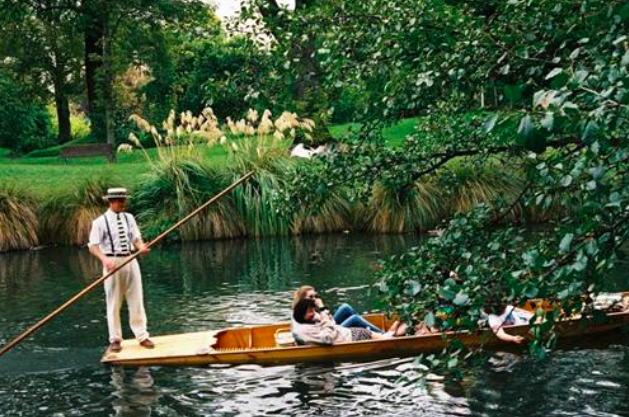
We set out on a walk after breakfast. Christchurch is an enjoyable city for strolling, and there is plenty to see on a circular walk from cathedral square. I will not go into the details of the various places to visit which includes the Canterburry Museum, Arts Centre and the Botanic Gardens. Information about them is documented well in the guide books. It is a fantastic walk without much hastle if you follow the tram lines. Christchurch is aptly named, the Garden City. There are many gardens, flower beds, water ways with ducks and mute swans in them to elicit interest from kids and adults alike. Nayantara would go ka-ka-ka on many occasions if she saw anything that looked like a bird.
We visited the Arts Centre and spent about an hour there. Some of the leading painters and sculptors work in the galleries and studios, along side other artists like musicians and craftpeople. We went into shops specializing in stained glass, carvings, ceramics, leather works, wooden toys, jade, bone and silver ware. We bought some wooden toys.
I had an interesting encounter with a bone carver by name Steve Kennedy. As I was passing his shop, I noticed a bearded, well built man assiduously carving with a tool on a piece of bone. My eye caught sight of a small picture depicting a famous scene in Mahabharata where Krishna is enlightening Arjuna, on his work table. I got curious about this and asked him why he had it there. Steve Kennedy then waxed eloquent about the wisdom in Bhagavat Gita. He was impressed that while modern science and philosophy was only recently understading the issues of absolute truth, whether the presence or absence of it, the Bhagat Gita and other ancient Indian wisdom had profound thoughts on it and articulated it so well centuries ago. He also talked about the various translations of the Gita by such scholars as Scarrow and Zeda (I hope I have got the spelling right), and how such translations fell short of conveying the Gita’s spirit. He seemed to have a good understanding of Christianity, Judaism, and other religions. He quoted several books and authors in a rapid fire fashion, although he stuttered a bit along the way. I was completely taken by this man who appeared to be doing the mundane task of carving ear rings on bone on a remote corner of the world, so far away from India, and yet was so Indian in his ideas and outlook. NVani was by now waiting impatiently behind me, waiting for me to disengage from this other-wordly talk, so that we could go and buy some wordly wooden toys. I came out after taking a picture of him.
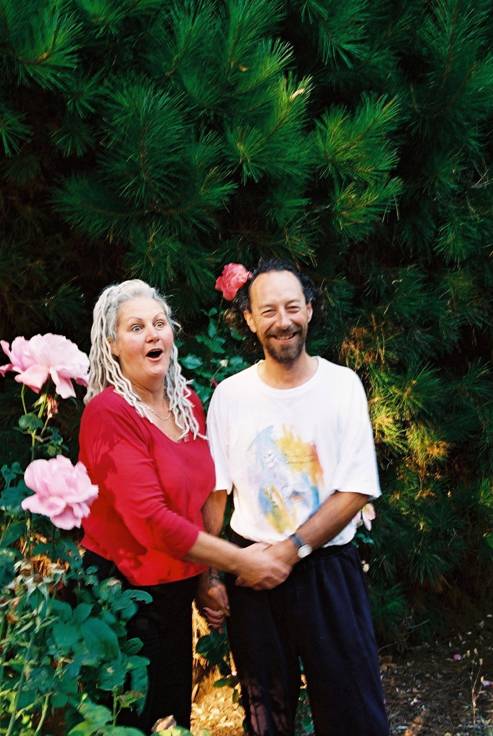
We wandered in the sylvan surroundings of the Botanic Gardens. The magnificent gardens covers an area of about 30ha within a loop of the Avon river. It is supposed to have very old trees including a tree planted in 1863 to commemorate the marriage of Prince Edward and Princess Alexandra of Denmark. The gardens are divided into a number of sections for roses, herbs, and so forth. We went into the roses section, and spent some time there taking pictures. MVani took video and pictures of all the different kinds of roses for her f-in-l’s study and reference. What a d-in-l! We noticed a rose plant named after Prince Charles. There was another rose plant with the scientific name ending as Lamesch. Ramesha posed infront of it for a picture at my request, while MVani slipped in surreptitiously beside him, putting her face close to his, struck by a sudden feeling of romance. Ramesha was shy at MVani’s public show of affection.
Homestay at Pear Drop Inn
We set off to the farmstay in the late afternoon from the Quality Autolodge Hotel in Christchurch where we were staying. Our driver was a stocky Polynesian, of mild demeanor. (There are 3 major races in the Pacific region – Micronesians, Melanasians and Polynesians. The world of Polynesia lies within a vast triangle stretching from Hawaii in the north, to New Zealand in the south and Easter island in the east.) An early naturalist described Polynesians on Captain Cook’s voyage as tall, athletic, light colored and of benevolent temperament. I thought, the word benevolent was an apt description of the soft, slightly sullen and motherly looks of this driver, and many other Polynesian taxi drivers we had seen.
Earlier on, we had encountered a huge Polynesian taxi driver on our return from Trans-Alpine train station in Christchurch. He was so big that he made the 12 seat van he drove seem small. I had felt tiny and insignificant sitting beside him in the front seat. Kalpana had remarked in her new found Kannada that I looked like an ant beside an elephant. His actions, however, were in direct contrast to his appearance. He would surprise us with bursts of childish chuckle (not unlike Raja himself), that transformed his face from one of solemn dignity to animated insouciance. Ramesha found the phenomenon mesmerizing and he urged us to look out for it.
Anyway, I was digressing. Our journey to the farmstay on the outskirts of Christchurch was pleasant and picturesque, although by now we had become quite used to the prettiness that New Zealand outdoors offered, and were involved in our own conversations, punctuated only rarely by perfunctory glances at the scenery outside. The discussions were largely lead by Ramesha, that great Link Master of ours, bestowed with such a title in appreciation of his enthusiasm for exploring, identifying and articulating family ties and links. The conversation nostalgically meandered about childhood memories, grandmothers, aunts, uncles, cousins and friends. Presently, we found ourselves on Old Tai Tapu road and realized we had lost our way. The address to the farmstay read as Tai Tapu road. Our driver was obviously new to the area, and had assumed the two names to refer to the same location. Ramesha called the farm a couple of times to get the directions right. When we finally reached the farm, the benevolence of the driver showed through. He apologized for losing his way and gave us a discount on the taxi fare.
Paula, our hostess was at the entrance to greet us. Husband Eric had driven off to look for us. It appeared it was common for visitors to lose their way here.
Paula is a striking lady with ash blond hair coiffured in some medusa-type of hairstyle. She was appealing even at her age (could be over 50) and in spite of a slight stockiness catching on her. We saw a photo of the couple in their living room, taken when they were much younger. Paula looked svelte and beautiful beside Eric, who looked a lot like Eric Clapton. Later, Eric seemed glad when I mentioned about his likeness to the famous singer and guitarist. Eric had a thick goatee, a balding forehead and a clump of coiled hair at the back of his head, slightly weather beaten face on account of his outdoors occupation of gardening, and most endearingly, bright smiling eyes.
The farmhouse was two storied. As we entered it, we came into a large kitchen and dining area with big wooden busts of comedians Laurel and Hardy. Eric and Paula had just returned from a week’s holiday themselves that morning, and had called Eric’s mother in Christchurch for help with cooking for our visit. To the right side of the entrance was the living room, carpeted and cozy. We came upon our rooms after climbing up the wooden staircase in the dining area. The rooms were both spacious, and had one big bed and two smaller beds on either side, in each room. The rooms were tastefully done up with some art deco wooden furniture, bed linen, small artifacts, artsy wall hangings, and most strikingly – fresh roses and dahlias, and fragrant dried flowers and leaves. All of us (more so was Ramesha) were very excited about the setup and the homely, relaxing feeling that the place induced in us. We wished we were here longer.
Nayantara and Manu immediately set about exploring the rooms in their own way – dismembering the dolls, twiddling with the switches on the bed lamp, shaking up the tables, toppling the table tops, and tearing apart the flowers. Before long they had redesigned and rearranged the rooms to suit their tastes. Presently, Eric brought in a baby cot, and two trays of refreshing snacks, consisting of apples, pears, kiwi fruits, bananas, and jugs of cool water with mint leaves floating on it for flavor. We partook this healthful fare while admiring the farm through the window.
When we came out to wander and look around in the farm, the sun was getting ready to set. Paula had explained it was misnomer-ed as a farmstay, while it was more apt to call it a homestay. Farmstays are larger areas amounting to few tens of acres of land where real farming, rearing of sheep and cattle, and milk and wool production were usually carried out. Pear Drop Inn, as Eric and Paula had purchased from the previous owner, was but a small piece of land amounting to only 2.5 acres, with the farmhouse built for the express purpose of entertaining visitors and boarders. Despite, the homestay still had airs about it of a farmstay. It had substantial area in the front-yard where many flowering and fruit bearing plants were grown. There were apple, pear and butter fruit trees. There were varieties of roses, dahlias, daisies, lilies, blossoms and others plants I can not name. There was one particular type of a very large rose that had blossomed into a beautiful flower emanating an alluring scent that seemed to fill the whole front yard. Something that brought memories of Bangalore for me was a creeper of divinely scented Jasmine flowers (Jaaji Mallige in Kannada). In my grandmother’s place in Bangalore, we had an arch at the entrance with the most magnificent creeper of Jasmine flowers that greeted every visitor.
There was a large tree in front of the farm house that would be visited and foraged by possums in the dark. Eric’s and Paula’s sheep dog, a Border Coolie by name Shadow, was particularly hateful of these possums and would bound at the tree from wherever he was, barking at imaginary possums. Shadow was a people’s dog as Eric said often, and liked people’s company. He took to us and particularly to Nayantara and Manu no sooner than we were introduced to him. He was just two years old and had grown into a handsome dog, with dark flowing mane and soft earnest eyes. Nayantara would bounce with glee and neigh like an excited horse at the sight of him. Shadow in turn would lick her with slurp-ful coatings of saliva. He would turn over on his back exposing his tummy for us to oblige him with soothing scratches, rubs and tickles. He would then run around in front of us, zig zagging with angular happy hops and skips as if to show us around the farm. We also met Brian’s (one of the two boarders) dog Alice – a cross between a poodle and a hound or a sheep dog.
At the back of the yard was a large area of trees, vegetable plants, a place where they made manure from horse dung, and a junk yard where I found an old and rusting boiler that had developed an artsy decayed look about it. There was a pumpkin creeper with a full-grown pumpkin secretly hiding below the leaves, about which Ramesha became absolutely excited. There were large cabbages lying about. There were many berries and colored seed plants. There was one very mauve colored, delicious-looking bunch of seeds that Ramesha could not resist tasting, for which he got reprimanded by MVani for being careless. There was also a small cage housing 5 rabbits. Further on there was a small pond with a tiny bridge over it. Beyond were some tall trees. The farm had a pet sheep by name Minty. Eric told me that the name Minty comes from a particular type of New Zealand delicacy, a lamb chop on which mint is used for flavouring. Preposterous!
By 7:30 PM Eric came by and told us that dinner was ready. Paula and her mother-in-law had set the dinner table with a fairly large spread of vegan dishes expressly prepared for us vegetarians. In particular, she had prepared a very delicious type of curry of horse gram (Hurali in Kannada), other lentils, chopped onions, spinach, tomatoes, and other unrecognizable vegetables whose juices had cooked and blended well. Paula said she used Cumin for flavoring. She seemed to favor cumin over other spices. There was a large bowl of rice, another vegetable dish, potatoes and chicken. We got introduced to Billy, a 18 year old boy from Hinan province in China, who was studying English, economics and business studies at the Lincoln university nearby. He had been staying with them for a few months now. He was the quietest at the table, only talking when talked to. The rest of the time, he had his head bowed down over the plate heaped with chicken legs and rice. He ate with single-minded focus, dexterously and hurriedly. When he had finished his dinner he slipped away from the table and disappeared into his room.
After dinner, tea and biscuits were served in the living room. Eric had a beer. Nayantara and Manu played on the carpet. Nayantara took her first steps on the carpet on that day. NVani was terribly excited about it. This rubbed on Nayantara herself, and she was giggling and screaming as she hobbled only a few steps to fall down to her knees, get up again and hobble some more. This went on for a while. We cheered Nayantara along, shouted and screamed, and created quite a racket in the living room. After a while, the children got tired of playing, and it was bedtime. MVani and NVani took the kids to the bedrooms to put them to sleep.
Eric’s mother bid us adieu. She would drive back to her place in Christchurch all by herself in the late night. Sprightly old woman. We were very impressed. But I guess, it is normal and all-in-a-days-work kind of thing for the hardy and fiercely independent New Zealanders.
Ramesha and I settled down on the sofa for a long chat with Eric, about life in New Zealand, his experiences and such. Eric worked part time as a Gardner at other farms, vineyards and houses to supplement his income from the farmstay. He had picked up much of his gardening skills from his father. He had refined his skills on-the-job. He said he did not get any formal training. He had earlier, before settling down in this farmstay business, worked in Italy and London as a painter and construction worker. He mentioned that he did have an opportunity to learn Italian, but somehow could not get upto scratch with the language.
(The couple seemed to have much interest in anything Italian – language, culture or cuisine. Paula was taking Italian language lessons, and Ramesha who knows the language fairly well on account of his work and stay in Italy, had many an opportunity to browbeat her with endless tips on nouns, verbs, conjugation, and what have you. In the course our stay there, Ramesha bowled Paula over with block diagrams and bubble diagrams of what he claimed as Italian grammar, on any stray bits of paper on the dining table. When Paula had come back from her Italian lessons the next day, very exasperated and agitated about her apparent dumbo-ness (her own words) in her failure to make any sense of what the teacher was saying, it was Ramesha who calmed her down by wielding his magic wand of Italian grammar mastery. Paula was well and truly impressed. She told me, but for him Italian would have remained Latin to her (not exactly in those words, though).
Eric, Ramesha and I went into lengthy discussions on farmstays, agriculture, real estate, petroleum, refineries, wine, politics, sheep dogs, childhood, possums, horse riding and much more. Eric gave us an interesting insight into his childhood. Eric is the last of the four siblings, and their family legend was that as a small boy he had this fixation with walking backwards until he hit his head on a wall. He wondered about this primordial affinity for many kids to walk backwards. Personally, I do not think I had that problem. Walking forward was by itself a major task for me, as our family legend goes. Anyway, when we were done with our profound conversation on the matters of the world, Ramesha retired to the bedroom, whereupon Eric and I went out to the chilly night to have a smoke. Now, smoking in a cold country is supremely pleasurable. Especially late in the night, with the stars twinkling above in the sky, and a serene silence all around in the countryside. Eric rolled me a cigarette from his Dutch do-it-yourself cigarette pouch. As we dragged pleasurably on our cigarettes, Eric narrated another tale about his pet lamb Minty, and how he had out-witted it once. Sheep are alleged to have a minute brain, and outwitting one is some kind of an oxymoron! Eric was full of such inane tales.
The plan for the next day was horse-riding in the morning, followed by a visit to the Rossendale Winery. Paula had on the previous day kindly made arrangements for these visits by calling up people. Eric drove us to the stud farm around 10:30 AM. It had a farmhouse, an open front yard with a tea table and a hammock, a large fenced field in which were a dozen horses either tethered or freely roaming about. Beyond there were green rolling hills and meadows where cows grazed. It appeared the farm was managed predominantly by a few ladies. We were met by a young girl of medium height and brown complexion, in riding breeches, boots and a hat. She was probably of Polynesian descent. She was the one who was to take us on the ride. With her was a British girl, who was on a holiday in New Zealand. She was spending her time for a few days in the farm and was flying off to Australia the next day. We were helped on with our helmets. Horses were readied with saddles. Ramesha was all along a little apprehensive about the ride as this was his first real one. The horses looked tall, muscular and full of energy. Looking at them increased his anxiety, I guess. We were helped to climb on to the horses from a raised platform.
We were given a quick briefing on the basics of horse riding:
-
You get on the horse from the left side of the horse.
-
Place your left foot in the stirrup and push up with your right. Use the saddle horn on top of the saddle to hang on.
-
Always take the reins in your left hand first. Do not let go of the reins the entire ride. The reins are your breaks and steering.
-
If the horse is just standing there, don’t pull back hard on the reins because the horse is going to start backing up or will rear up.
-
The finer points of control of a rental horse are as follows. Pull the reins right to go right, pull the reins left to go left , and pull the reins back to slow down or try to stop, while saying aloud “WOO BOY, WOO BOY”.
-
To go is much more complicated. However, the best way to do this is , let the reins out a little, giving a little kick with your heals and clicking your tongue , click click click, and using the word command yeah, yeah, YEAH or loud kissy noises.
-
Don’t get nervous. Keep your breathing normal.
 Eclectic Musings by Ranga Sitaram
Lovely read!! Relived every moment almost 15 years later!!
LikeLike
Thanks Raja!
LikeLike